
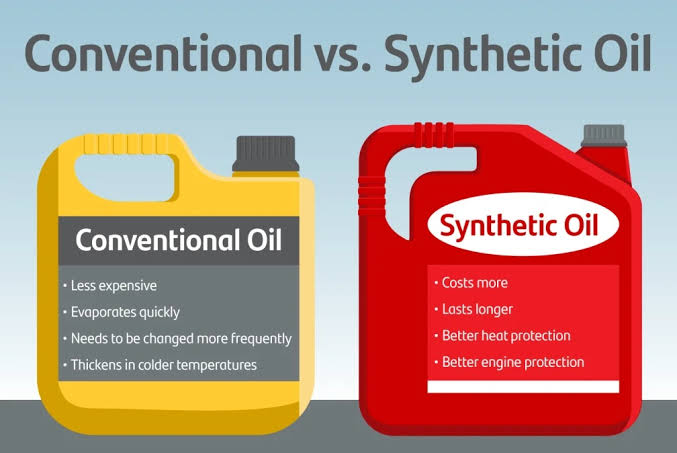
I spent some time looking into this because I hear the question a lot from friends and family who drive older cars in Lagos traffic or make long hauls up north. After reading through mechanic forums, oil company specs from places like Mobil and Castrol, and real-user stories on sites like Reddit and Consumer Reports, plus checking what works in hot climates like ours, I can break it down simply. The choice between synthetic and conventional oil comes down to your car’s needs, your driving habits, and your budget. In Nigeria, where heat pushes engines hard and dust clogs everything, picking the right one keeps your Corolla or Civic running without burning oil or overheating. Let us get into what each is, how they differ, and when one beats the other.
Conventional oil comes straight from crude oil pumped from the ground. It goes through refining to remove impurities, but it still has a mix of different molecule sizes. That means it is not uniform, some parts break down faster than others under stress. It has been the standard for decades, and for basic engines in milder conditions, it does the job. You add some detergents and anti-wear stuff during production, but nothing fancy. In our weather, though, it thins out quick in 38-degree heat, leading to more friction and wear. It also forms sludge easier if you do short trips, like school runs in Abuja, because contaminants build up.68f2a6
Synthetic oil, on the other hand, is made in a lab. Engineers build it from base stocks, often starting with natural gas or refined petroleum, but they tweak the molecules to be consistent in size and shape. This makes it flow smoother, resist heat better, and protect parts longer. Full synthetics have advanced additives for cleaning, reducing leaks, and handling extreme temps. A synthetic blend mixes synthetic bases with conventional to give some benefits at a lower price. From what I found in Mobil’s breakdowns, synthetics stay stable in wide temperature ranges, which is huge here where mornings can be cool during harmattan but afternoons bake everything.d02396
Now, the real differences start with composition. Conventional is natural and variable, like a home-cooked meal with whatever is around. Synthetic is engineered for precision, more like a factory product designed for performance. That uniformity lets synthetic flow better at startup, reducing wear when the engine is cold, and it does not evaporate or thicken as much in heat. In tests I read about on mechanic sites, synthetics can handle 20 to 30 degrees higher temps before breaking down compared to conventional.103eb9 This matters in stop-go traffic where your engine idles hot.
Performance-wise, synthetic wins in protection. It creates a stronger film between moving parts, cutting friction and extending engine life. For turbo engines or high-revving ones, it prevents breakdowns that conventional might allow. It also cleans better, dissolving deposits that cause sludge, which is common in our adulterated fuel. Conventional does okay for basic lubrication but forms gunk faster, especially if you skip changes. In a Consumer Reports piece, they noted synthetics can last up to 10,000 miles between changes, while conventional tops out at 5,000 to 7,500 in normal use.31c624 But in Nigeria, with our dust and heat, shorten both intervals, aim for 5,000 kilometers max for conventional and 8,000 for synthetic.
On longevity, synthetic lasts longer in the engine, meaning fewer changes and less waste. It resists oxidation, so it does not turn acidic and corrode parts as quick. Conventional oxidizes faster in heat, leading to varnish on internals. For high-mileage cars over 150,000 kilometers, synthetic often has seal conditioners to reduce leaks, something conventional lacks unless you add extras.
Cost is where conventional shines. A five-liter jug runs 25,000 to 35,000 naira, while synthetic hits 45,000 to 65,000. Over time, though, synthetic pays off with longer intervals and better protection, potentially saving on repairs. In older engines, some say conventional’s thicker nature seals better, but from Reddit mechanics, that is outdated, modern synthetics match viscosities fine.94ec9a Synthetics are slipperier, reducing drag and sometimes boosting fuel economy by 1 to 2 percent, per Castrol data.ee86be
Pros of synthetic: superior in extreme temps, cleans better, lasts longer, reduces wear, great for modern or turbo engines.
Cons: pricier upfront, and in very old cars without proper seals, it might leak more at first until conditioners work.
For conventional: affordable, works for basic daily drivers, no overkill for low-stress use.
Downsides: shorter life, more sludge, weaker in heat, needs frequent changes.
When to choose synthetic? If your car is 2010 or newer, has a turbo, or you drive long distances like Abuja to Kano, go synthetic. It handles our conditions better, as seen in VP Racing notes on resisting sludge.130482 For older, simple engines under 100,000 kilometers with short commutes, conventional is fine if you change often. Blends offer a middle ground for budgets.
Always check your manual for the right viscosity, like 5W-30, and API rating. Buy from trusted spots to avoid fakes, which are rampant here. In the end, synthetic edges out for most, but conventional still has its place. Pick based on your drive, and your engine stays happy longer.