
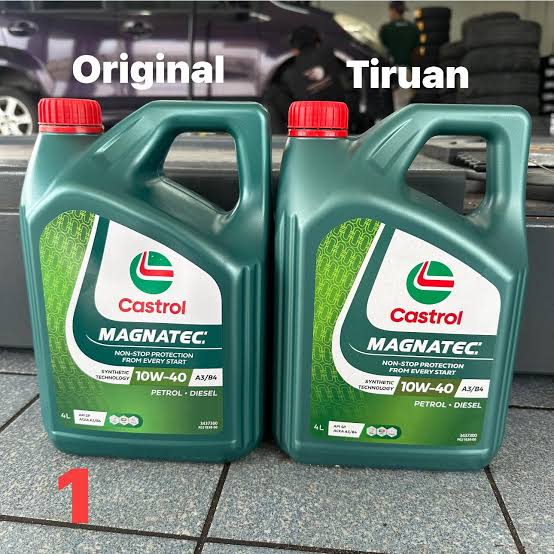
Fake engine oil is everywhere in Nigerian markets right now. Walk through Ladipo, Ogba, or any roadside spare-parts stall and you will see shelves full of containers labeled Castrol, Mobil 1, Shell Helix, Total Quartz, or Petronas Syntium. Some are genuine, many are not. Using counterfeit oil can destroy an engine in a few thousand kilometers: bearings seize, pistons score, rings wear out prematurely, and you end up with a rebuild that costs ₦300,000 or more. The good news is that fakes usually give themselves away if you know what to look for. Here are the most reliable ways to separate real from fake before you pour anything into your sump.
Packaging Tells the Story First
Genuine bottles have consistent, high-quality printing. Labels are sharp, colors are accurate, and fonts are uniform. Fakes often have blurry text, misaligned logos, or spelling mistakes (“Syntetic” instead of “Synthetic”, “Quatz” instead of “Quartz”). The batch code and manufacturing date are laser-etched or printed clearly on the back or bottom of real bottles; on fakes the code is either missing, printed in weak ink, or looks stamped by hand. Check the cap seal—originals have a tight, tamper-evident ring that breaks cleanly when opened. Many fakes use loose caps or cheap foil seals that tear unevenly.Feel the plastic. Genuine bottles use thick, slightly flexible HDPE that does not dent easily. Cheap fakes feel thin and brittle; they often have visible mold lines or air bubbles in the plastic. Shake the bottle gently—real synthetic or semi-synthetic oil is usually uniform and does not separate quickly. If you see heavy sediment settling at the bottom within seconds, it is almost certainly adulterated with used oil or cheap base stock.
Price Is a Warning Sign
If a 4-liter bottle of Mobil 1 5W-30 or Castrol EDGE 5W-40 is selling for ₦12,000 when legitimate dealers charge ₦28,000–₦35,000, it is fake. Same with Shell Helix Ultra or Total Quartz 9000—genuine ones rarely drop below ₦25,000 for 4 liters in 2026. Importers and distributors pay import duty, VAT, clearing fees, transport, and rent. Anyone selling at half price is either smuggling or refilling with inferior base oil. The exception is during genuine promotions from official distributors (Oando, TotalEnergies, Eterna), but even then discounts are 10–20%, not 50%.
Smell and Color Give Clues
Open the cap and smell. Real synthetic oil has a clean, slightly chemical odor. Fake oil mixed with used engine oil smells burnt, acrid, or like old diesel. Color is another giveaway—fresh synthetic is usually amber to light gold. Dark brown or black oil straight from the bottle is recycled used oil. Some fakes add dye to mimic the right hue, but the smell still gives them away.
Check the Oil Itself (Dipstick Test)
If you already bought and want to confirm before pouring, do a quick check. Pour a small amount on a clean white paper towel. Genuine oil spreads evenly with a smooth edge and no heavy sediment ring. Fake oil often leaves a dark, uneven stain with particles or a strong burnt smell. Viscosity feel matters too—real 5W-30 feels slick and light between your fingers; adulterated oil can feel too thick or thin.