
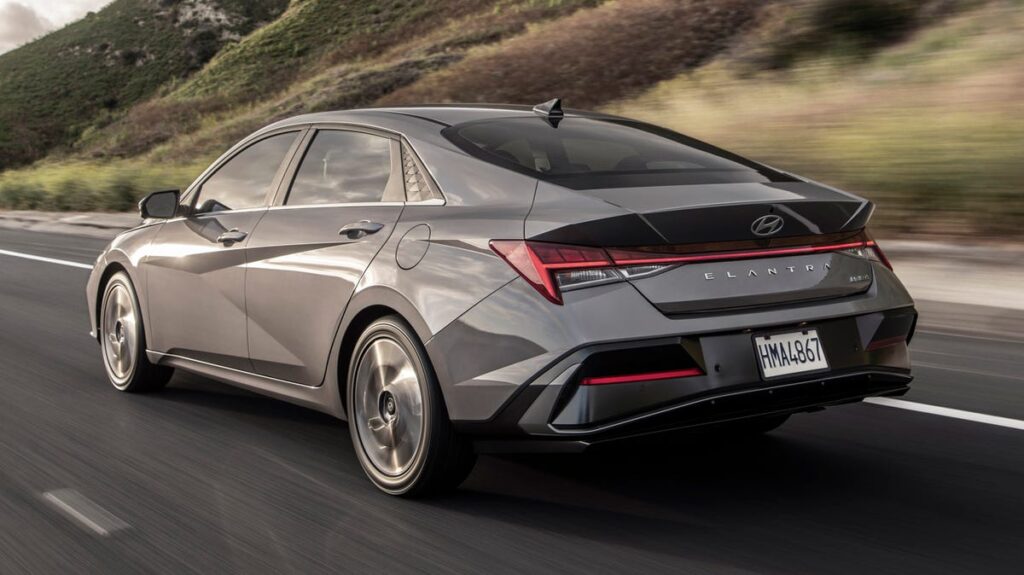
The 2026 Hyundai Elantra keeps doing what it has always done best: deliver a lot of car for the money without making you feel like you compromised. Hyundai updated the sedan for 2026 with sharper styling, a few more standard features, and better efficiency, but the core strengths—quiet ride, spacious cabin, low running costs, and solid reliability—remain unchanged. For Nigerian drivers who need something comfortable for city traffic, reliable on long highway runs, and affordable to maintain when potholes or bad fuel take their toll, the Elantra is still one of the strongest choices in the compact segment.The exterior gets a mild facelift that makes it look fresher without straying far from the previous design. The front grille is slimmer and more horizontal, with new LED headlights that are thinner and more aggressive. The hood line is cleaner, and the side profile keeps the fastback-like roofline that gives the Elantra a sporty feel. Rear taillights are connected by a slim light bar that looks modern at night. Ground clearance is around 135–140 mm enough to handle most urban potholes and speed bumps but not suited for very rough rural tracks. The overall design is aerodynamic, which helps keep wind noise low and improves fuel economy on open roads.
Powertrain options are focused on efficiency. The base engine is a 2.0-liter four-cylinder producing about 147 horsepower and 132 lb-ft of torque. It pairs with a CVT that shifts smoothly in stop-go traffic. Real-world fuel economy in Nigerian mixed driving (heavy city plus some highway) typically lands at 11–14 km/l, which is strong for the class. The hybrid version, available on most trims, combines a 1.6-liter four-cylinder with electric motors for a total system output of around 139 horsepower. The hybrid returns 18–22 km/l in city conditions and can touch 24 km/l on open roads significant savings when petrol prices rise or stations run dry. The hybrid battery carries an eight-year or 160,000 km warranty, and Hyundai’s hybrid systems have proven reliable in hot, humid climates.
The interior is where the 2026 Elantra feels most improved. Materials are a step up more soft-touch surfaces on the dash and door panels, less hard plastic in high-contact areas. The dashboard layout is clean and driver-focused, with physical knobs for climate control that are easy to adjust without looking away from the road. The standard 10.25-inch touchscreen is sharp and responsive, with wireless Apple CarPlay and Android Auto on most trims. Higher models get a 12.3-inch screen that integrates well with the digital instrument cluster. Front seats are supportive with good cushioning, and rear legroom is generous for adults. Trunk space is around 402 liters plenty for weekend luggage or market shopping.
Safety is a strong point. Hyundai SmartSense is standard across the range. It includes forward collision-avoidance assist with pedestrian and cyclist detection, lane-keeping assist, lane-following assist, adaptive cruise control with stop-and-go, blind-spot collision-avoidance assist, and rear cross-traffic collision-avoidance assist. In real Nigerian driving, the adaptive cruise makes stop-go traffic far less tiring, and lane assist helps on highways when fatigue sets in. Blind-spot monitoring is a lifesaver in crowded cities. The Elantra consistently earns top marks in global crash tests, with strong structure and good occupant protection.
Ride quality is tuned for comfort. The suspension handles potholes well for a compact sedan, and road noise is well controlled for the class. Steering is light and precise, making it easy to maneuver in tight urban streets or park in crowded markets. The cabin stays quiet at highway speeds, which is appreciated on longer drives.
Ownership costs are reasonable. Parts are increasingly available and affordable, mechanics are getting familiar with Hyundai, and insurance premiums stay competitive. Fuel efficiency, especially in the hybrid, keeps running costs down. Resale value is improving Hyundai is gaining trust in the Nigerian used market.
The 2026 Elantra is not trying to be the most exciting sedan to drive. It is trying to be the one you can rely on for years without constant worry. In Nigeria, where reliability, low running costs, and family practicality often matter more than anything else, it remains one of the most balanced compact sedans you can buy. Test drive the hybrid version if possible the efficiency and smooth power delivery will likely convince you.