
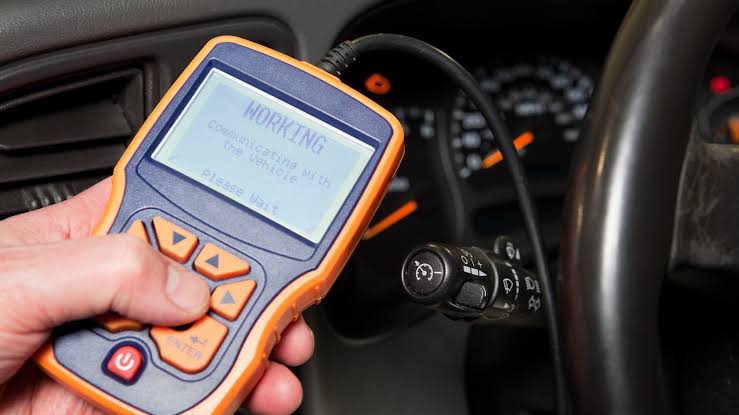
An OBD scanner has become one of the most useful tools for any car owner in Nigeria. It allows you to read diagnostic trouble codes, monitor live engine data, and often clear warning lights without immediately rushing to a mechanic. With fuel quality issues, heavy traffic, heat, and dusty conditions stressing vehicles daily, an OBD scanner helps you understand what is happening under the hood before small problems become expensive repairs. Here is a clear, practical guide on how to use one effectively in 2026.First, understand what an OBD scanner actually does. OBD stands for On-Board Diagnostics. Almost every car made after 2008 in Nigeria has an OBD-II port, usually located under the dashboard near the steering column or fuse box. When something goes wrong, the car’s computer stores a trouble code and often turns on the check engine light. A scanner plugs into this port and communicates with the car’s electronic control unit (ECU) to read those codes, show live sensor data, and sometimes perform special tests.Choose the right scanner for your needs. Basic code readers (around ₦5,000–₦15,000) simply display trouble codes and let you clear them. More advanced Bluetooth or Wi-Fi scanners (₦15,000–₦50,000) connect to your phone and offer live data, freeze-frame snapshots, and enhanced diagnostics for specific brands like Toyota, Honda, or Hyundai. For most Nigerian drivers, a Bluetooth scanner paired with a good Android or iOS app such as Torque Pro, Car Scanner ELM OBD2, or OBD Auto Doctor provides the best balance of cost and capability. Make sure the scanner supports your car’s protocol—most post-2008 vehicles use CAN protocol.Before plugging in the scanner, park the car on level ground, turn off all accessories, and make sure the engine is either off or idling depending on what you want to check. Insert the scanner firmly into the OBD-II port. For Bluetooth models, turn on the scanner, pair it with your phone via Bluetooth settings, and open the diagnostic app. The app will automatically connect once paired. If the connection fails, check that the ignition is on (engine does not need to be running for basic code reading) and try again.Once connected, the first screen usually shows current trouble codes. Each code starts with a letter (P for powertrain, B for body, C for chassis, U for network) followed by four numbers. For example, P0301 means a misfire on cylinder 1. Write down every code exactly as it appears. The app will usually give a short description such as “random misfire” or “oxygen sensor circuit low.” Some apps also explain possible causes and suggest next steps. Take note of pending codes (problems that have been detected but not yet severe enough to turn on the check engine light) and permanent codes (more serious issues that cannot be cleared until the problem is fixed).Look at freeze-frame data if available. This shows sensor readings at the exact moment the fault was detected, including engine speed, coolant temperature, vehicle speed, and fuel trim values. Freeze-frame data is extremely helpful for diagnosing intermittent problems that only occur under specific conditions.
Next, check live data. This is where the scanner becomes truly useful. You can monitor real-time values such as engine RPM, coolant temperature, oxygen sensor readings, fuel trim, intake air temperature, throttle position, and battery voltage. For example, if the car is running rough, watch the short-term and long-term fuel trim numbers. Values consistently above +10 % or below -10 % often indicate vacuum leaks, dirty injectors, or failing sensors. High coolant temperature while idling in traffic can warn of a failing thermostat or clogged radiator.After noting the codes and live data, decide whether to clear them.
Clearing codes turns off the check engine light temporarily, but the light will return if the underlying problem is not fixed. Only clear codes after you have recorded them and attempted to diagnose the issue. Some codes, especially misfires or emissions-related faults, may require driving cycles before they reappear.
Common codes you will encounter in Nigeria include P0171 and P0172 (system too lean or too rich), P0300–P0304 (misfire codes), P0420 (catalyst efficiency), P0130–P0135 (oxygen sensor issues), and P0442 (evaporative emission leak). Many of these are caused by bad fuel, dirty sensors, vacuum leaks, or failing spark plugs problems that are very common with our fuel quality and dusty conditions.After the scan, turn off the ignition, unplug the scanner, and test-drive the car if you cleared any codes.
Monitor whether the check engine light returns and whether the symptoms improve. Keep a record of all codes, dates, and actions taken. This history is extremely helpful for mechanics and when selling the car later.An OBD scanner is not a replacement for a good mechanic, but it gives you valuable information and helps you ask the right questions when you take the car for service. It also prevents unnecessary repairs by showing exactly what the computer has detected.
Keep your scanner in the glove box, learn the common codes for your specific car model, and use it regularly. You will catch small problems early, save money, and drive with more confidence knowing what is happening inside your engine.