
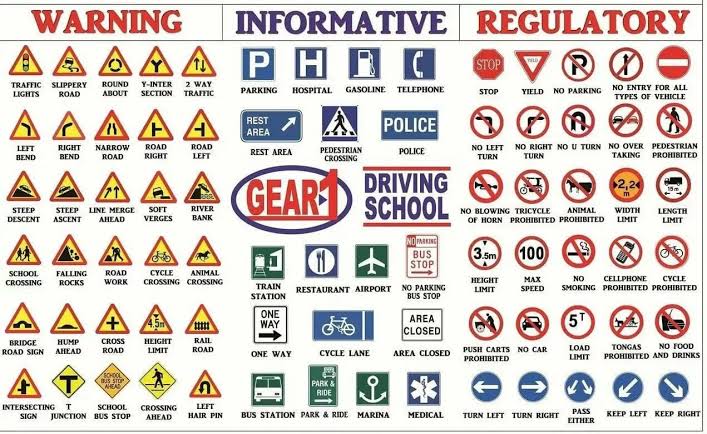
Nigerian roads can feel chaotic until you learn what the signs and markings are actually telling you. Once you do, they become your best allies for staying safe and avoiding fines. The Federal Road Safety Corps (FRSC) sets the standards based on international conventions, but local conditions like heavy traffic, poor maintenance, and inconsistent enforcement make it essential to know them well. Here is a straightforward breakdown of the main types you will encounter every day, explained clearly so you can recognize and follow them without second-guessing.
Regulatory Signs (What You Must Do or Must Not Do)
These signs have the force of law and ignoring them usually means a fine. The most common are circular with a red border. A red circle with a diagonal line through a symbol means prohibition. For example, a red circle with a black car and a slash means no entry for vehicles. A red circle with a black arrow pointing left means no left turn. Speed limit signs are also regulatory: a black number inside a red circle means you must not exceed that speed in kilometers per hour. The white background with black text “STOP” in a red octagon is universal, come to a complete stop at the line. Yield signs (upside-down triangle with red border and white background) mean give way to traffic already on the road. Disregarding these signs causes many junction crashes.
Warning Signs (Heads-Up for Hazards)
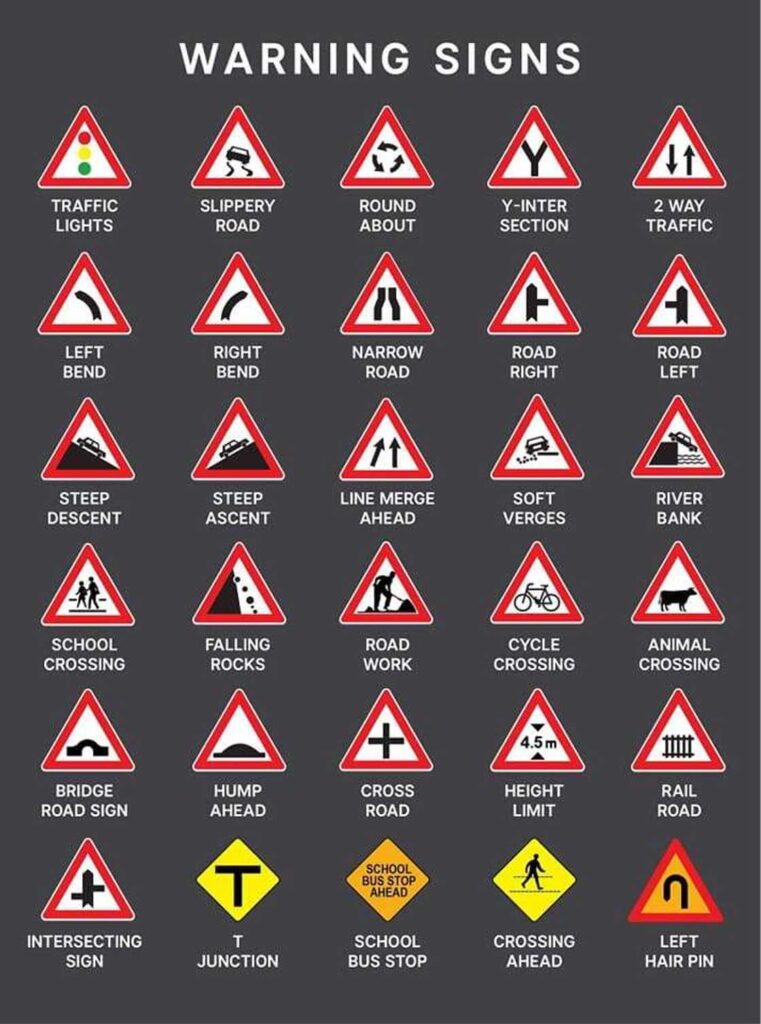
These are usually triangular with a red border and a black symbol or picture inside. They warn of danger ahead so you can slow down and prepare. The most frequent ones include sharp curve ahead (curved black arrow), steep descent (downward black arrow with percentage), narrow bridge (two converging black lines), pedestrian crossing (black figures walking), school zone (children crossing), and animal crossing (silhouette of cow or goat). On highways, you will see “road works ahead” (black figure digging) or “slippery when wet” (car skidding). These signs save lives because they give you time to reduce speed. In rural areas, animal and pedestrian signs are especially important at dusk.
Informative and Guide Signs (Helping You Navigate)
These signs tell you where you are and where to go. Blue rectangular signs with white text or symbols guide you to places like hospitals, petrol stations, airports, or rest areas. Green signs with white text and arrows show directions and distances to towns and cities. Brown signs point to tourist sites or historical places. Route number signs (white background with black number) help you stay on the right highway. These signs are lifesavers when you are traveling long distances or in unfamiliar cities.
Road Markings (The Lines on the Pavement)
Markings guide you even when signs are missing or faded. White solid lines mean do not cross. White broken lines allow overtaking when safe. Double white lines (one solid, one broken) mean do not cross if the solid line is on your side. Yellow lines are for no overtaking zones, especially on hills or curves. Arrows painted on the road show lane usage, straight arrow means straight only, curved arrow means turn. Zebra crossings (white stripes) require drivers to give way to pedestrians. Speed humps are marked with white triangles pointing forward. Speed limit markings on the road (large white numbers) remind you of the limit.
Traffic Lights and Pedestrian Signals
Red means stop completely. Amber (yellow) means prepare to stop, do not speed up to beat it. Green means go if the way is clear. Flashing amber at night or in low traffic usually means proceed with caution. Pedestrian signals (red standing figure means wait, green walking figure means cross) are increasingly common in cities like Lagos and Abuja.
Why Understanding These Saves Lives
Many accidents happen because drivers ignore or misunderstand signs. Speed limit signs get ignored, no-overtaking zones are treated as suggestions, and warning signs for curves or pedestrians are overlooked. When everyone follows them, the roads become safer. The FRSC reports that poor observance of signs and markings contributes to a large percentage of crashes. Taking a moment to read and respect them reduces risk dramatically.
Pay attention to signs and markings every time you drive. They are there to protect you and others. Learn them, obey them, and encourage passengers to do the same. Safer roads start with drivers who know what the signs mean.