
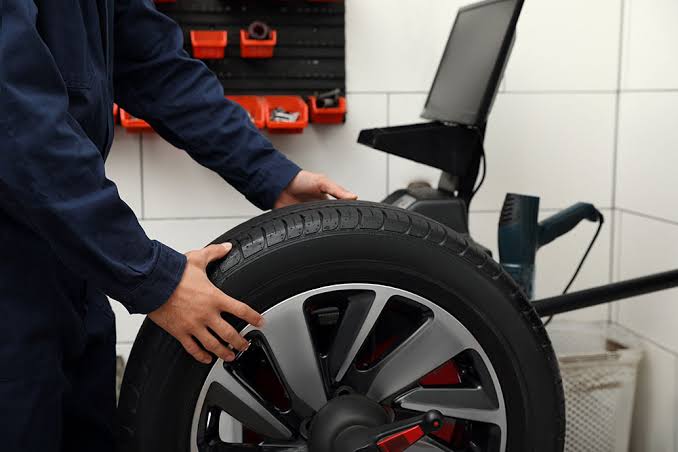
Tire rotation and balancing are two of the simplest yet most effective maintenance tasks that can extend the life of your tires, improve fuel economy, ensure even wear, and keep your car handling safely on Nigerian roads. Many drivers skip these services until they notice vibration, pulling, or rapid tire wear, but performing them regularly prevents expensive problems and gives you a smoother, more comfortable ride.Tire rotation means moving each tire to a different position on the vehicle at regular intervals.
The main reason for rotation is that tires wear differently depending on their position. Front tires on front-wheel-drive cars usually wear faster on the outer edges due to the constant steering and weight transfer during cornering. Rear tires tend to wear more evenly or in the center. On rear-wheel-drive vehicles, the drive tires experience more torque and wear differently again.
Rotating the tires spreads this wear evenly across all four tires so they last longer and maintain better performance until the end of their life.For most passenger cars and SUVs in Nigeria, experts recommend rotating tires every 8,000 to 10,000 km or every six months, whichever comes first. If you frequently drive on rough or potholed roads, carry heavy loads, or do a lot of stop-and-go driving in city traffic, consider rotating every 6,000 to 8,000 km.
The common rotation patterns are the forward cross (front tires move straight back, rear tires cross to the front) and the rearward cross. Your mechanic will choose the pattern that best suits your vehicle’s drive type and tire design. Always rotate in the direction recommended by the tire manufacturer to preserve any directional tread patterns.Balancing is equally important. When a tire is mounted on a rim, small weight differences can cause it to spin unevenly. These imbalances create vibrations that you feel through the steering wheel or floor, especially at highway speeds.
Over time, unbalanced tires cause uneven wear, premature tire failure, and extra stress on suspension components such as shocks, struts, and wheel bearings.During balancing, the mechanic mounts the tire and wheel assembly on a balancing machine that spins it at high speed and identifies heavy spots. Small lead or zinc weights are then clipped or stuck onto the rim to counteract the imbalance. Most workshops in Nigeria perform both static and dynamic balancing, which corrects imbalances in both vertical and horizontal planes. It is best to balance tires whenever they are rotated or whenever you notice vibration at certain speeds.
Combining rotation and balancing during the same service is the most efficient approach. Many reputable workshops offer a combined package that includes rotation, balancing, and a quick alignment check. This service usually costs between ₦8,000 and ₦15,000 for a standard sedan or small SUV, depending on the location and workshop. While it may seem like an extra expense, it often extends tire life by 20–30 percent and improves fuel efficiency by reducing rolling resistance.
Pay attention to the signs that rotation and balancing are needed. Uneven tread wear, vibration at highway speeds that disappears at lower speeds, the car pulling to one side, or a humming noise that changes with speed are all indicators. If you notice any of these symptoms, do not wait until the next scheduled service.
Have the tires inspected and serviced immediately.When having your tires rotated and balanced, ask the mechanic to inspect the tread depth, check for cuts or bulges in the sidewalls, and examine the condition of the valves and valve caps. Proper valve caps prevent air leaks and keep dirt out of the valve stem.
Also request that they check the tire pressure and adjust it to the manufacturer’s recommended levels (usually found on the driver’s door jamb sticker). Correct tire pressure is essential for even wear and good fuel economy.For vehicles with directional or asymmetric tires, make sure the mechanic follows the correct rotation pattern and mounting direction. Directional tires can only rotate in one direction, while asymmetric tires have different tread patterns for the inside and outside of the wheel. Installing them incorrectly reduces performance and safety.After rotation and balancing, drive gently for the first 50–100 km to allow the weights and tires to settle. Listen for any new vibrations or noises.
If you feel anything unusual, return to the workshop for a re-check, as sometimes a weight can come loose during the first drive.Regular tire rotation and balancing are among the smartest and most cost-effective maintenance habits you can adopt. They help your tires wear evenly, improve handling and braking, increase fuel efficiency, and extend the overall life of your tires.
In Nigeria’s demanding road conditions, these two services can easily add thousands of kilometres to the life of your tires and save you money in the long run.Make tire rotation and balancing part of your routine every 8,000 to 10,000 km. Your car will ride smoother, handle better, and your tires will last longer, giving you better value and greater safety on the road.