
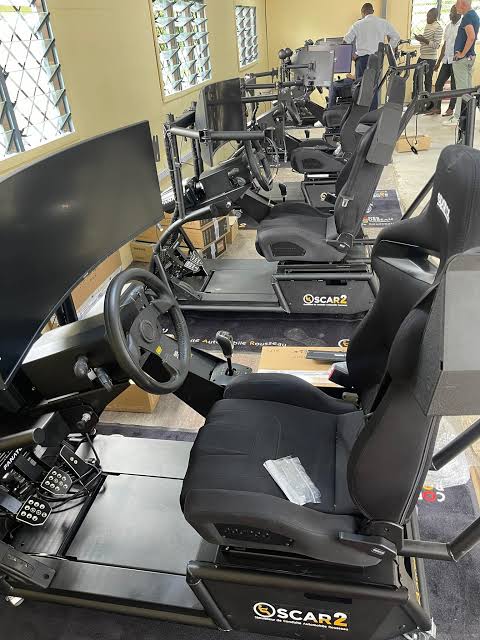
Simulator Training vs Real Road Practice: What FRSC Schools UseLearning to drive in Nigeria involves more than just memorising road signs and traffic rules. The practical side of training is where most learners build real confidence and skill. In FRSC-approved driving schools, both simulator training and real road practice are used, but they serve different purposes and are combined in specific ways to produce competent drivers. Understanding how these two methods work together helps you choose the right school and know what to expect during your training.Simulator training is a controlled, safe environment where beginners can learn basic vehicle controls without the pressure of actual traffic. Modern driving simulators use realistic steering wheels, pedals, seats, and screens that replicate road conditions, traffic signals, pedestrians, and weather scenarios. In FRSC-approved schools, simulators are mainly used during the early stages of training. Learners practise starting the engine, changing gears, steering, braking, and basic manoeuvres such as reversing and parking. The biggest advantage is safety. Mistakes made in a simulator have no real consequences, so students can repeat difficult manoeuvres until they get them right. Simulators are especially useful for teaching hazard perception and decision-making in dangerous situations, such as a child suddenly crossing the road or a vehicle running a red light. They also allow instructors to create specific scenarios that are difficult to arrange safely on real roads.However, simulators have clear limitations. They cannot fully replicate the feeling of actual vehicle movement, the forces of acceleration and braking, or the unpredictable behaviour of other road users. For this reason, FRSC-approved schools use simulators only as a supplementary tool, not as a replacement for real road practice. The national curriculum requires a minimum number of hours of actual driving on public roads under the supervision of a certified instructor in a dual-control vehicle.Real road practice is where learners develop the most important skills: situational awareness, defensive driving, and the ability to react safely in live traffic. In FRSC-approved schools, students begin real road sessions after they have mastered basic controls in the simulator or on a quiet training ground. Instructors gradually introduce learners to increasingly complex environments, starting with low-traffic residential streets and progressing to busier roads and highways. This step-by-step approach builds confidence while keeping safety as the top priority.During real road practice, instructors focus on teaching defensive driving techniques that are especially relevant in Nigeria. Students learn how to maintain safe following distances, anticipate the unpredictable movements of motorcycles and danfo buses, manage blind spots, and respond correctly at roundabouts and junctions. They also practise driving in different conditions, including rain, harmattan dust, and low-light situations when possible. The dual-control vehicle allows the instructor to take over instantly if the student makes a mistake, providing an important safety net.Most FRSC-approved schools combine both methods in a structured way. The first few weeks may focus more on simulator and closed-ground practice to build basic skills and confidence. As the course progresses, the majority of training hours shift to real road practice under supervision. This blended approach ensures learners develop both technical control and the judgement needed for safe driving in real Nigerian traffic.
When choosing a driving school, it is wise to ask how they balance simulator and real road training. A good school will be transparent about the number of hours allocated to each and will show you their training vehicles and simulator facilities. Schools that rely too heavily on simulators and offer very little real road practice may not be preparing students adequately for actual driving conditions. On the other hand, schools that rush students onto busy roads without sufficient basic training can create unnecessary risk.The ultimate goal of FRSC-approved training is to produce drivers who are not only technically skilled but also safety-conscious and responsible. Simulator training provides a safe foundation for learning controls and basic reactions, while real road practice develops the awareness, anticipation, and decision-making skills needed to navigate Nigeria’s complex road environment safely.
By understanding how FRSC-approved schools use both simulator training and real road practice, you can make a more informed choice when selecting a driving school. The right combination of both methods gives learners the best preparation for passing the FRSC driving test and, more importantly, for becoming safe, confident drivers on Nigerian roads for years to come.A well-balanced training program that includes both simulator sessions and sufficient real road practice is the most effective way to learn driving properly.
When you enrol in an FRSC-approved school, ask detailed questions about their training structure so you can be confident you are receiving the right balance of safety and real-world experience.