
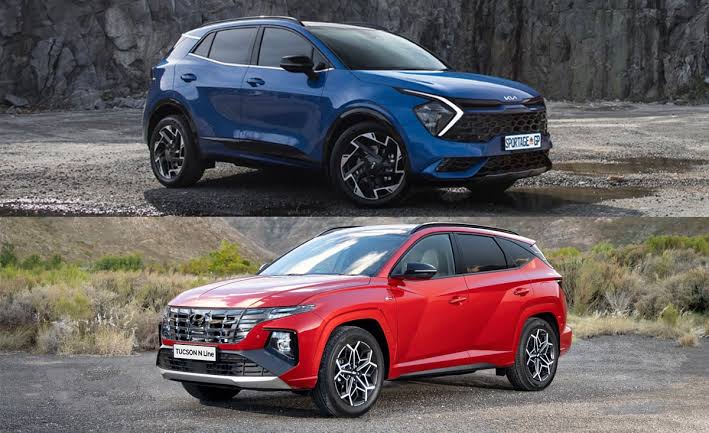
When Nigerian buyers compare the Kia Sportage and Hyundai Tucson, conversation often turns to features, fuel economy, or ride comfort. Yet for long-term ownership the more practical question is how easily and affordably spare parts can be obtained. Both vehicles come from the same Hyundai Motor Group family and share significant engineering DNA, but real-world parts availability in Lagos, Abuja, and other major centres still shows small but meaningful differences that owners should understand before choosing.
The two models have overlapping platforms across several generations. Many mechanical components, including certain engines, transmissions, suspension pieces, and braking systems, are related or identical. This shared architecture means that a mechanic familiar with one can usually work on the other without major difficulty. In markets such as Ladipo in Lagos, it is common to find traders who stock items labelled for both Hyundai Tucson and Kia Sportage, sometimes even selling the same physical part under either name depending on the customer’s request.Wear-and-tear items are the easiest category for both vehicles.
Brake pads, discs, filters, shock absorbers, stabiliser links, ball joints, and bushes appear regularly in the aftermarket. These parts are consumed quickly on Nigerian roads, so demand has encouraged steady supply. Prices remain higher than equivalent Toyota or Honda items, yet they are generally obtainable without long waits in major cities. Cooling system components such as radiators, water pumps, and thermostats also circulate reasonably well, which is important given the heat and traffic conditions that stress these systems.
Body panels, lights, and trim pieces tell a slightly different story. Front and rear bumpers, fenders, headlamps, and tail lamps for popular years of both the Tucson and Sportage can be found in used and aftermarket form. However, exact colour-matched panels or newer-generation specific designs may require ordering. Sellers who specialise in Korean vehicles often keep mixed stock, so a shop that can supply a Tucson bumper frequently has Sportage equivalents as well. Waiting times for less common body parts can stretch from a few days to a couple of weeks depending on the specific year and whether the part must come from outside the immediate market.Official dealer networks influence the picture too.
Hyundai has been represented in Nigeria for a longer period through established distributors, which has helped build a broader base of trained technicians and a more predictable channel for genuine parts. Kia’s official presence has grown, supported by its distributor and previous local assembly activity on some models, yet the volume of Tucson examples on the road in certain age brackets still gives Hyundai a modest edge in everyday parts turnover. Independent specialists who focus on Korean cars usually handle both brands and source from the same pools of new, used, and aftermarket components.Electronics and sensors form another area of consideration.
Modern Tucson and Sportage models carry more complex control units, parking sensors, camera systems, and transmission electronics. These items are available but often command higher prices and may need to be ordered specifically for the exact model year and engine variant. Diagnosis typically requires capable scanners, so owners benefit from using workshops that already service both brands regularly.Generation matters a great deal. Older third- and fourth-generation examples of both SUVs have better current parts support simply because more of them have entered the used market and mechanics have seen the common failure points repeatedly. Newer fifth-generation models still have thinner local stock for certain body and interior pieces, although mechanical consumables remain accessible. Buyers of recent examples should confirm that their preferred workshop can obtain the less common items within a reasonable time.
In practical ownership terms the difference between the two is rarely dramatic. A well-maintained Sportage does not suddenly become difficult to repair while a Tucson remains easy, or vice versa. The shared platform works in the owner’s favour. What does vary is the density of vehicles of a particular year in a given city and the habits of local traders. In Lagos, both are visible enough that competent Korean-car specialists can keep either on the road. In smaller cities the advantage may tilt toward whichever model is more numerous locally.
For a buyer deciding between the two, parts availability should sit alongside other factors such as purchase price, fuel consumption, and personal preference for styling or features. Neither vehicle matches the parts ubiquity of a Toyota RAV4 or Honda CR-V, yet both have reached a level where routine maintenance and most common repairs can be handled without excessive drama in major urban centres. Choosing a clean example with service history, confirming that recalls or technical campaigns have been addressed, and establishing a relationship with a knowledgeable Korean-vehicle workshop will matter more than the badge on the grille.
The Sportage and Tucson remain closely matched in the parts arena because they were engineered as relatives. Nigerian owners who keep up with regular servicing and avoid neglected high-mileage examples generally find that obtaining the necessary components is manageable for either vehicle.
The real showdown is less about one brand defeating the other and more about selecting the individual car that has been properly cared for and matching it with competent local support.