
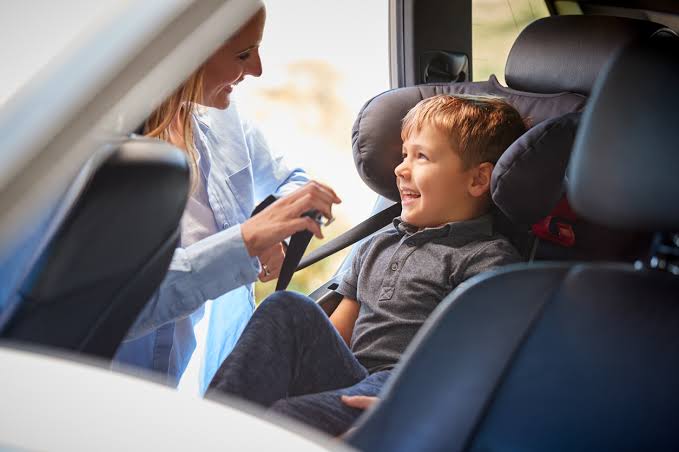
Protecting children in vehicles is one of the clearest responsibilities a driver has, yet many Nigerian parents still travel with kids unrestrained or sitting in the wrong position. The Federal Road Safety Corps has specific rules on child restraints and seating, and these rules carry fines and penalty points. Understanding what the law requires and what officers actually look for helps families stay compliant and, more importantly, keep children safer on the road.
According to current FRSC regulations and the National Road Traffic Regulations, every person in a moving vehicle must wear a seatbelt. For children, the rules go further. Children under 12 years old are required to sit in the back seat and use an age-appropriate child restraint. Failure to do so is recorded as a child restraint violation or child sitting position violation.
The standard penalty is a ₦3,000 fine and six penalty points.FRSC public education materials give practical guidance that aligns with these rules. Infants from birth to about 12 months should ideally travel in a rear-facing child seat and should not be placed in the front seat. Where a child must sit in front for any reason, a rear-facing restraint is strongly advised. Children roughly between one and seven years should use a forward-facing child seat properly strapped into the back seat. Older children who have outgrown child seats should still sit in the back and use the adult seatbelt correctly until they are big enough for the belt to fit properly across the shoulder and hips.Carrying a child on your lap is explicitly discouraged and unsafe. In a crash the adult’s body can crush the child against the dashboard or seat in front.
Children should also not ride in the luggage area of hatchbacks or station wagons, and it is illegal to transport children under 16 in the open back of a pickup van.In practice, FRSC enforcement of child restraint rules is visible but not as consistent as enforcement of adult seatbelt use or speeding. Officers on patrol and during special operations do book drivers for child restraint and seating violations. Records from mobile courts and special intervention patrols occasionally list child restraint offences among the charges. However, many families still travel with children unrestrained, especially on short trips or in commercial vehicles, because enforcement can be uneven and public awareness remains limited.
When officers stop a vehicle, they typically check whether young children are in the front seat without proper restraint and whether any child restraint is being used at all. A child sitting freely on the back seat or on an adult’s lap is more likely to attract attention than a child in a booster seat that is not perfectly adjusted. Still, the law is clear: the driver is responsible for ensuring children are properly restrained.Using the correct restraint matters more than simply having one. A child seat that is not suitable for the child’s weight and height, or one that is not properly installed, offers reduced protection.
Parents should choose restraints that match the child’s size and follow the manufacturer’s installation instructions carefully. Many modern cars have ISOFIX points that make secure installation easier.Commercial vehicles and school transport present particular challenges. Enforcement is generally stricter with private cars than with shared taxis or buses, yet the legal responsibility still rests with the driver. Parents who put children in commercial vehicles should still insist on the safest available seating and avoid placing small children in the front.
The safest approach is to treat every trip the same, no matter how short. Install an appropriate child restraint before the journey begins, place the child in the back seat, and ensure the harness or seatbelt is correctly adjusted. Keep the child lock on the doors engaged. These habits protect children far better than relying on an adult’s arms or an unrestrained seat.
FRSC continues to include child safety in its public education campaigns and lists the relevant offences in its penalty schedule. While enforcement may not yet match the seriousness of the risk, the rules exist and officers do issue fines. More importantly, proper child restraints dramatically reduce the chance of death or serious injury in a crash.
Making child restraints a non-negotiable part of family travel is one of the simplest and most effective safety steps a parent can take. The law supports it, the science supports it, and every child’s life is worth the effort.