
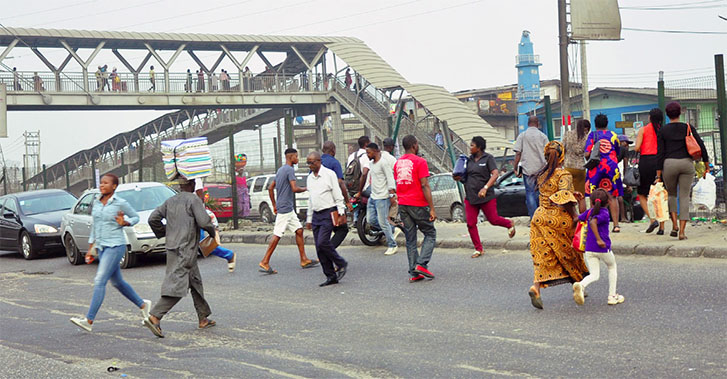
In cities such as Lagos, Abuja, Port Harcourt and Kano, pedestrian crossings are meant to create safer points for people to cross busy roads. Zebra crossings, signalised junctions and footbridges exist in theory to give pedestrians a protected space while requiring drivers to yield. In practice, the gap between the rules and daily reality remains wide, leaving both walkers and motorists exposed to unnecessary risk.
Under Nigerian traffic regulations, pedestrians have the right of way at designated zebra crossings once they have stepped onto the crossing. Drivers are expected to stop and allow them to cross. Overtaking another vehicle at or near a pedestrian crossing is prohibited because it creates a serious hazard. At signalised junctions, pedestrians must follow the pedestrian lights or the general traffic signals and should not enter the crossing against a red light. Where footbridges or subways are provided, especially across expressways, pedestrians are expected to use them rather than dart across high-speed carriageways.These rights come with corresponding responsibilities. Pedestrians are advised to wait until it is safe, make eye contact where possible with approaching drivers, and cross promptly without lingering.
Crossing outside designated points, particularly on expressways, is both dangerous and often illegal. In Lagos, authorities have repeatedly warned that crossing expressways instead of using pedestrian bridges can lead to arrest and prosecution.The risks on the ground are significant. Many drivers treat zebra crossings as optional markings rather than mandatory stopping points. Vehicles frequently speed through crossings even when pedestrians are waiting or already on the road. This forces people to run, hesitate, or abandon the crossing altogether. At the same time, large numbers of pedestrians continue to cross expressways at ground level despite the presence of footbridges. Reasons range from the height and condition of the bridges, concerns about security especially after dark, inconvenience, or simple habit. The result is a steady toll of pedestrian casualties, including children and the elderly who are particularly vulnerable.
Enforcement remains the weakest link. While agencies such as the Federal Road Safety Corps, LASTMA in Lagos, and equivalent bodies in other cities have the legal power to penalise drivers who fail to yield and pedestrians who cross illegally, consistent application is uneven. Fines exist on paper for example, failure to give way at zebra crossings can attract penalties in Lagos yet many motorists report rarely seeing officers specifically monitoring pedestrian crossings.
In Abuja, observers have noted that zebra crossings are frequently ignored with little visible consequence for drivers. On expressways, enforcement against illegal pedestrian crossing tends to be sporadic rather than continuous, so compliance rises briefly during crackdowns and then declines.Infrastructure problems compound the enforcement gaps. Some zebra crossings are faded or poorly located. Others lack adequate lighting or advance warning signs for drivers. Footbridges may be too few, poorly maintained, or perceived as unsafe because of poor lighting and the presence of touts or criminals. When the safe option feels inconvenient or risky, people choose the shorter, more dangerous path.Improving the situation requires action from several sides.
Drivers need consistent education and visible enforcement so that yielding at crossings becomes normal rather than exceptional. Pedestrians benefit from better-designed, well-lit and secure footbridges together with clear, well-maintained zebra crossings at appropriate points. Traffic authorities can close the enforcement gap by assigning officers specifically to high-risk crossing locations during peak hours and by publicising penalties when they are applied. Urban planners should treat pedestrian movement as a core part of city design rather than an afterthought.
Both groups share responsibility. A driver who slows and stops at a zebra crossing protects lives and models better behaviour. A pedestrian who uses a footbridge or waits for a safe gap reduces the chance of a sudden, tragic collision. Children should be taught early to use designated crossings and never to run into the road.
Pedestrian crossings only work when the rules are understood, respected and enforced. In major Nigerian cities the legal framework exists, but daily practice still lags behind. Closing that gap would make walking safer, reduce avoidable deaths, and create a more orderly relationship between those on foot and those behind the wheel. Until enforcement becomes consistent and infrastructure supports safe choices, both pedestrians and drivers will continue to carry unnecessary risk every time they share the road.