
Nigeria must urgently move beyond policy announcements and execute a coordinated six-point roadmap if the country is to turn growing interest in electric vehicles (EVs) into mass adoption, Metropolitan Electric Limited has warned.
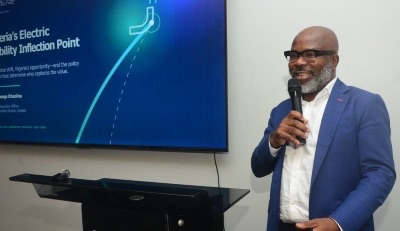
The company’s Chief Executive Officer, Olugbenga Obadina, made the call while speaking at the 3rd Nigeria Auto Industry Summit, organised by the Nigeria Auto Journalists Association (NAJA) in conjunction with the National Automotive Design and Development Council (NADDC) in Lagos.
Obadina said Nigeria had reached a critical stage in its transition to electric mobility, stressing that the major challenge was no longer policy formulation but coordinated implementation across government agencies.
He noted that several important building blocks were already in place, including the National Automotive Industry Development Plan (NAIDP) 2023–2033, which targets a 30 per cent local EV production share and 40 per cent local content.
He also cited the zero-rating of VAT on EVs and semi-knocked-down assembly parts under the Nigeria Tax Act 2025, the reported reduction of EV import duty from five per cent to zero under the 2026 Fiscal Policy Measures, and government initiatives covering EV procurement, charging infrastructure, standards, recycling and skills development.
But Obadina warned that these measures would not automatically create a viable EV market if investors and operators continued to face uncertainty, inconsistent tariffs, customs delays and demurrage costs.
“Investors price execution certainty, not policy intention,” he said.
To move Nigeria from growing EV interest to mass adoption, Metropolitan Electric proposed what it described as a six-point “Nigeria EV Compact.”
The company called for a stable 10-year national EV roadmap under a single coordinating body with sufficient authority to align the activities of relevant government agencies. It also urged government to create anchor demand by progressively increasing EV procurement quotas for government fleets and public transportation.
Another key recommendation is to “finance kilometres, not cars” through a naira-denominated green-mobility facility, credit guarantees and multi-year leasing arrangements.
The company also called for charging infrastructure to be treated as regulated infrastructure, with standardised permits, defined service levels and transparent tariffs.
It advocated performance-based localisation, with incentives linked not simply to vehicle assembly but to actual production, quality, employment, component manufacturing, research and development and exports.
The sixth recommendation is stronger consumer and investor confidence through technician certification, transparent warranty disclosure, battery-health standards and clear end-of-life regulations for batteries.
Obadina stressed that Nigeria should not seek to sustain EV adoption through permanent subsidies but should create a commercially viable market capable of attracting finance, supporting local production and eventually competing without extraordinary government support.
“The objective is not permanent subsidy. It is a bankable market that scales, localises and eventually competes,” he said.
He also advised Nigeria against attempting to replicate the private-car-led EV transition experienced in wealthier countries. Instead, he said the country should prioritise vehicles that clock high daily mileage, including buses, logistics vehicles, institutional fleets, motorcycles and tricycles.
Such vehicles, he explained, operate intensively enough to enable investments in EVs and charging infrastructure to generate returns faster.
Charging infrastructure, he added, should consequently be planned around actual depots, routes and daily driving patterns rather than deployed without considering vehicle utilisation.
Obadina pointed to Metropolitan Electric’s own operations as evidence that electric mobility can work in Nigeria when the ecosystem is properly coordinated.
Since 2023, he said, the company has supplied, deployed and maintained more than 200 EVs, with another 150 units ordered. It has also deployed more than 6MW of charging infrastructure and operates in Lagos, Abuja, Abeokuta, Port Harcourt and Kaduna.
Obadina challenged policymakers, investors and journalists to judge Nigeria’s EV transition by actual performance rather than announcements.
He urged stakeholders to focus on the number of EVs operating daily, cost per kilometre, charging uptime, warranty performance and who ultimately bears the risks associated with batteries, financing and recycling.
“Count what operates, not what is announced,” he said.
According to Obadina, Nigeria’s EV future must ultimately be “engineered, assembled, financed, charged and maintained here.”