
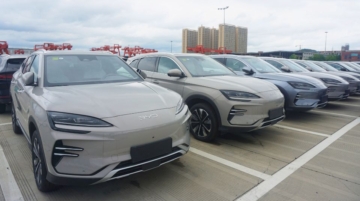
Chinese electric vehicle brands are establishing a presence in Nigeria with far less fanfare than the global headlines that accompany their expansion elsewhere. Instead of large public launches or aggressive advertising campaigns, the entry has been practical, partnership-driven, and closely tied to local economic realities. High fuel prices following subsidy removal, the search for lower running costs, and the availability of competitively priced models have created openings that Chinese manufacturers and their Nigerian partners are steadily filling.
One of the clearer signals has been the arrival of BYD through established distribution channels. The brand, already a major global EV player, has made models such as the Atto 3 and Dolphin available via partners linked to larger automotive groups. These vehicles are positioned as practical options rather than luxury statements, with ranges and features suited to urban and intercity use. Official distribution brings the advantage of structured after-sales support, warranties, and access to genuine parts, which many earlier informal imports lacked.
Geely has taken a similar route. Through TIM Motors, the Geely Galaxy range of new-energy vehicles has been introduced in Lagos, complete with showroom presence, trained technicians, and an emphasis on building a service ecosystem rather than simply selling cars. The approach reflects a recognition that Nigerian buyers need confidence in long-term support before committing to unfamiliar technology.Local assembly is another quiet but significant channel. Companies such as Saglev have begun assembling electric vans and passenger vehicles using kits supplied by Chinese manufacturers, including Dongfeng-related brands. These operations aim to reduce import costs, create local jobs, and produce vehicles better adapted to Nigerian road and usage conditions. Other partnerships, including plans for larger production capacity involving Chinese engineering firms and Nigerian assemblers, point toward a gradual shift from pure importation toward local value addition.
Beyond pure battery-electric models, Chinese brands that already sell petrol and hybrid vehicles in Nigeria are expanding their electrified offerings. Names such as Chery, Jetour, MG, GAC and others have built dealer networks and brand recognition through conventional models. Adding hybrids or full EVs to those existing channels allows them to test demand without starting from zero. Fleet buyers and corporate users, sensitive to fuel costs, have shown early interest in these options.The strategy is deliberately low-key for several reasons. Charging infrastructure remains limited outside major cities, and reliable grid power is not guaranteed. Public awareness of EV ownership costs, battery longevity, and residual values is still developing. By working through experienced local distributors, focusing on models with practical range, and pairing sales with service capability, Chinese brands reduce the risk of early negative experiences that could damage reputation.
Economic pressure has been the strongest accelerator. When petrol prices rose sharply, the total cost of ownership calculation changed for many drivers and fleet operators. Chinese EVs and hybrids often undercut equivalent European or Japanese alternatives on purchase price while promising lower energy costs per kilometre. Solar-assisted charging solutions and emerging battery-related services are beginning to address the power reliability concern, though progress is uneven across the country.
Challenges remain substantial. Widespread public charging networks are still sparse. Battery replacement costs and long-term parts availability will need to prove themselves over time. Consumer financing for EVs is limited compared with conventional vehicles. Yet the pattern of entry suggests Chinese manufacturers are treating Nigeria as a market that rewards patience and local adaptation rather than rapid volume chasing.The result is a gradual, almost understated presence. Dealerships in Lagos and other cities now display Chinese EV and hybrid models alongside more familiar brands. Assembly lines are producing small but growing numbers of electric commercial vehicles. Partnerships continue to expand. For Nigerian buyers the practical effect is greater choice at a time when fuel costs remain high and the search for affordable, efficient transport is more urgent than ever. Chinese EV brands are not announcing a sudden takeover. They are simply making themselves available, one practical step at a time.