
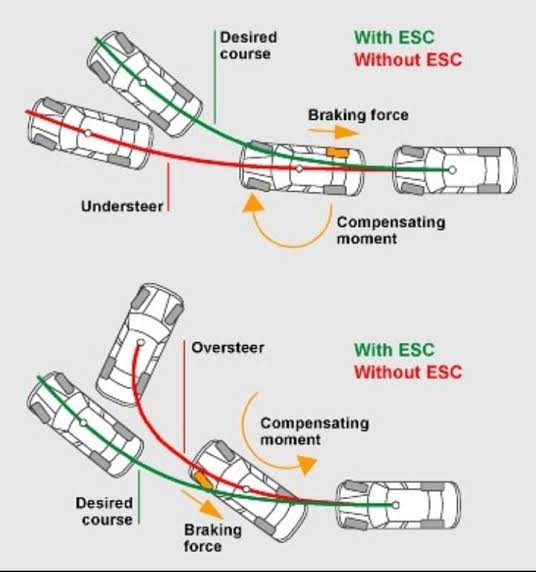
Electronic Stability Control is one of the most effective safety technologies fitted to modern cars, yet many drivers only notice it when a warning light appears on the dashboard. On Nigerian roads, where sudden swerves, uneven surfaces, wet patches and unpredictable traffic are routine, ESC can help keep a vehicle under control when grip is about to be lost. Understanding what it does, which popular models carry it, and why it matters allows buyers to treat it as more than just another specification line.ESC is a computerised system that continuously monitors the direction the driver is steering and the direction the car is actually travelling. Wheel-speed sensors, a steering-angle sensor and a yaw sensor feed data to a control unit.
When the system detects that the car is beginning to slide either the front pushing wide in understeer or the rear stepping out in oversteer it intervenes. It can apply the brake to individual wheels and, if necessary, reduce engine power. The correction happens automatically and far faster than most drivers can react. The goal is to bring the vehicle’s path back into line with the driver’s intended direction and prevent a spin or complete loss of control.The technology builds on Anti-lock Braking System hardware and often works alongside traction control. While ABS prevents wheel lock under braking and traction control limits wheelspin under acceleration, ESC addresses the sideways sliding that occurs during cornering or emergency manoeuvres. In practical terms it helps when a driver enters a bend too quickly, swerves to avoid a pothole or an okada, or hits a slippery patch while changing direction. On wet roads after rain, on surfaces with mixed grip, or during the abrupt lane changes common in heavy traffic, the system provides an invisible safety net.
Availability of ESC has increased steadily across the models that dominate the Nigerian Tokunbo market. Many Toyota Corollas from the mid-2010s onward include it, especially in higher trims and later years of each generation. Camry models of the same period frequently carry the system as standard or as part of a stability-control package. Honda Civics and Accords followed a similar path; later examples of both nameplates commonly feature Vehicle Stability Assist, Honda’s name for the same technology. SUVs such as the RAV4, CR-V and Highlander also adopted ESC widely, which is particularly useful given their higher centres of gravity. Exact fitment still varies by year, market and trim, so checking the specific vehicle remains essential.A dashboard icon that looks like a car with skid marks beneath it is the usual indicator that the system is present; the light should illuminate briefly at start-up and then go out.
Why the system matters in Nigeria is tied directly to local driving conditions. Roads are often uneven, with potholes that force sudden avoidance. Rain turns dusty surfaces into low-grip zones and creates puddles that hide changes in traction. Mixed traffic of cars, buses, motorcycles and pedestrians produces frequent emergency swerves. Many vehicles carry heavy loads or travel with partially worn tyres. In these situations the margin between a controllable slide and a spin can be small. ESC narrows that margin by intervening before the driver fully loses control. Studies in other markets have shown significant reductions in single-vehicle crashes and rollovers once ESC became widespread; the underlying physics apply equally on Nigerian roads.
ESC is not a substitute for sensible driving or proper maintenance. It cannot defy the laws of physics if speed is excessive for the available grip. Worn tyres, incorrect pressures or damaged suspension components reduce the system’s ability to help. The electronics need functioning wheel-speed sensors and a healthy brake system to operate. A warning light that stays on means the system is disabled and should be diagnosed. In some older cars the system can be switched off manually; leaving it on is the safer default for normal road use.For buyers comparing Tokunbo cars the presence of ESC should rank alongside dual airbags, ABS and sound structural design. A Corolla, Camry, Civic, Accord or RAV4 that includes the system offers a measurable safety advantage over an otherwise similar example that lacks it. Because fitment became more common through the 2010s, later model years are more likely to have it as standard. Confirming its presence during inspection both by checking for the warning-light behaviour and, where possible, by scanning the vehicle’s systems avoids assuming that every car of a given model is equally equipped.
Electronic Stability Control works quietly in the background until the moment it is needed. On roads that demand constant small corrections and occasional sharp reactions, that background intervention can prevent a slide from becoming a crash. Choosing a popular model that includes ESC, keeping the tyres and brakes in good order, and driving with the system enabled gives the technology the best chance to do its job when grip suddenly disappears.