
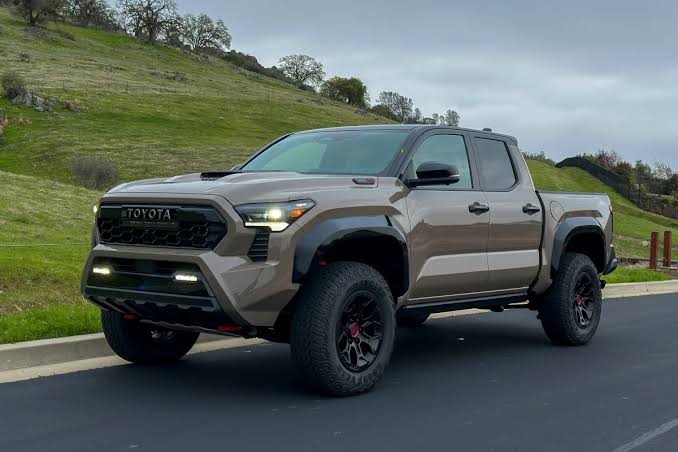
The Toyota Tacoma has been the go-to midsize pickup in markets where reliability and toughness matter more than flash. For 2026, Toyota keeps that reputation while making the truck noticeably better in areas Nigerian owners care about: handling rough rural roads, surviving heavy loads, staying comfortable on long hauls, and keeping repair costs manageable. The changes are not revolutionary, but they address real complaints from drivers who use these trucks for work, family trips, and everything in between.
The exterior design is bolder than before. The front grille is more upright and aggressive, with C-shaped LED headlights that give the face a tougher, more modern expression. The hood has stronger lines, and the side profile keeps the high beltline and squared-off wheel arches that make the Tacoma look capable. Ground clearance is around 239–274 mm depending on trim and suspension package, which clears deep ruts, rocks, and flooded sections better than most competitors. The double-cab body is the most popular choice in Nigeria, offering four full doors and a usable rear seat. The load bed is still generous, with tie-down points, composite material that resists dents, and a tailgate that supports heavy weight.
Engine options are focused on torque and durability. The base engine is a 2.4-liter turbocharged four-cylinder producing about 278 horsepower and 317 lb-ft of torque on higher trims. It pairs with an eight-speed automatic that shifts smoothly under load. Real-world fuel economy in Nigerian mixed driving (city plus highway, often loaded) typically lands at 8–11 km/l, which is acceptable for a truck this capable. The hybrid version (i-FORCE MAX), available on higher trims, combines the 2.4-liter turbo with electric motors for a total system output of around 326 horsepower and 465 lb-ft of torque. The hybrid returns 10–13 km/l loaded, which is impressive for the power and makes long rural runs less painful on fuel. The hybrid battery carries an eight-year or 160,000 km warranty, and Toyota’s hybrid systems have proven reliable in hot, dusty conditions.
The interior is where the 2026 Tacoma makes the biggest leap. Materials are tougher and feel more premium more soft-touch surfaces on the dash and door panels, better stitching on seats, and less hard plastic in high-contact areas. The dashboard layout is clean and functional, with physical knobs for climate control that are easy to use with gloves or dirty hands. The standard 8-inch touchscreen is responsive, with wireless Apple CarPlay and Android Auto on most trims. Higher models get a 14-inch screen that looks modern and integrates well with the digital instrument cluster. Front seats are supportive with good cushioning, and rear legroom in the double cab is adequate for adults on long trips. Cargo space in the load bed is massive, with tie-down points and a tailgate that can support heavy weight.
Safety is improved and practical. Toyota Safety Sense 3.0 is standard on most trims. It includes pre-collision braking with pedestrian detection, lane departure alert with steering assist, adaptive cruise control, automatic high beams, and road sign recognition. In real Nigerian driving, the adaptive cruise makes highway runs less tiring, and lane assist helps when fatigue sets in on long trips. Blind-spot monitoring and rear cross-traffic alert are standard or optional depending on trim, and they are useful in busy traffic. The Tacoma consistently earns strong crash-test ratings, with a robust frame designed to protect occupants in rollovers or heavy impacts important on roads where accidents often involve trucks or overloaded vehicles.Ride quality is tuned for work and comfort. The leaf-spring rear suspension handles heavy loads and rough terrain without sagging, and the front double-wishbone setup keeps the ride composed over potholes. Road noise is well controlled for a pickup, and the cabin stays quiet at highway speeds. Steering is light enough for city use but firm enough to feel confident on dirt tracks.
Ownership costs are low by pickup standards. Parts are widely available and affordable, mechanics know the Tacoma inside out, and insurance premiums stay reasonable. Fuel efficiency is acceptable for its capability, and resale value remains extremely strong Tacomas hold their price better than almost any other vehicle in Nigeria.
The 2026 Tacoma is not trying to be the most luxurious or fastest truck. It is trying to be the one you can rely on for years of hard work, family trips, and daily driving without constant worry. In Nigeria, where durability, parts availability, and low running costs often matter more than anything else, it remains one of the most practical pickups you can own. If you need a truck that can do everything from city errands to remote village runs, the Tacoma is still the benchmark.