
Stakeholders seek local manufacturing, cheaper financing, charging infrastructure and crackdown on uncertified CNG conversions
Nigeria’s transition to electric vehicles (EVs) and Compressed Natural Gas (CNG) transportation requires more than policy announcements, as stakeholders at the 3rd Nigeria Auto Industry Summit (NAISU 2026) have called for a comprehensive national roadmap backed by measurable targets, tougher standards and sustained investment.
The stakeholders specifically urged the Federal Government to establish a National Clean Mobility Roadmap covering EV adoption, CNG expansion, infrastructure development, local vehicle manufacturing and technology transfer.
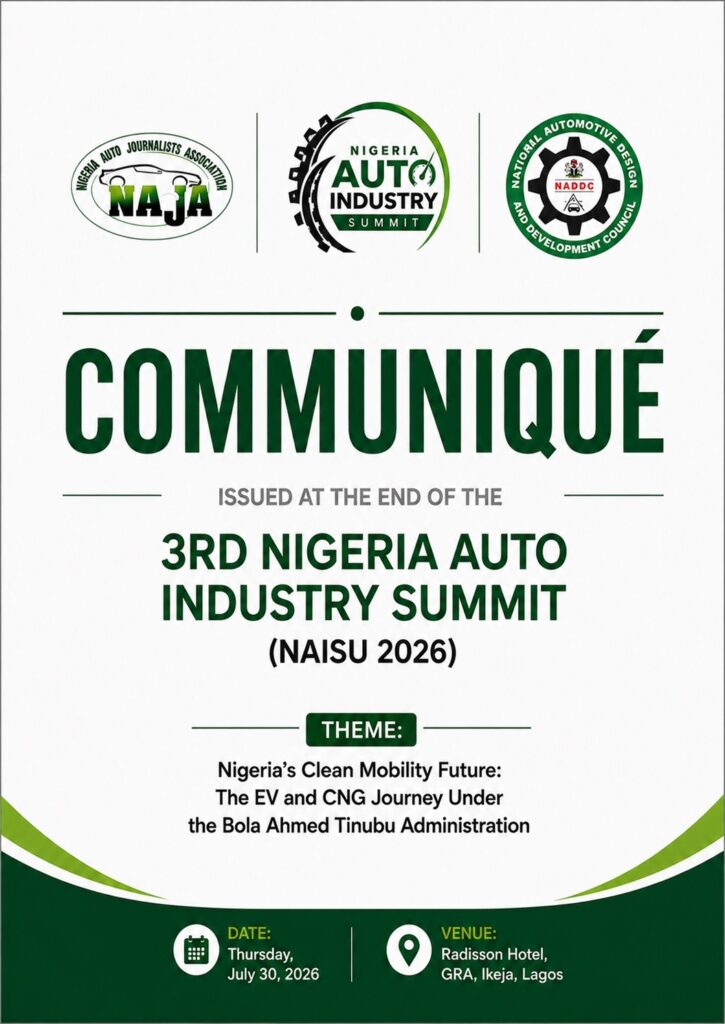
The demand was contained in the communiqué issued at the end of NAISU 2026, organised by the Nigeria Auto Journalists Association (NAJA) in collaboration with the National Automotive Design and Development Council (NADDC).
The summit, held on July 30 at the Radisson Hotel, Ikeja, Lagos, brought together representatives of NADDC, the Presidential Initiative on CNG and Electric Vehicles (Pi-CNG & EV), Standards Organisation of Nigeria (SON), Federal Road Safety Corps (FRSC), Federal Fire Service, Lagos Chamber of Commerce and Industry (LCCI), automotive component manufacturers and other industry stakeholders.
With the theme “Nigeria’s Clean Mobility Future: The EV and CNG Journey Under the Bola Ahmed Tinubu Administration,” participants acknowledged progress in the country’s clean-mobility drive but warned that policy consistency, infrastructure investment, strict standards and collaboration among government agencies would determine its success.
One of the strongest recommendations was the demand for mandatory certification of all imported and locally assembled EVs and CNG vehicles, conversion kits, charging systems and related equipment under SONCAP, MANCAP and the proposed Vehicle Conformity Assessment Scheme.
The summit also called for the immediate licensing and accreditation of CNG conversion centres nationwide, with continuous monitoring to ensure that only certified technicians carry out vehicle conversions.
This, stakeholders said, would help address safety concerns arising from poorly executed conversions and the use of substandard equipment.
The summit also wants the private sector to play a bigger role in developing the infrastructure needed for clean mobility. It recommended fiscal incentives, access to finance and public-private partnerships to encourage investment in CNG refuellingstations, EV charging networks and battery-support facilities.
But beyond putting more clean-energy vehicles on Nigerian roads, the stakeholders want the transition to become a catalyst for industrialisation.
They called for stronger incentives for local vehicle assemblers, component manufacturers and Original Equipment Manufacturers, as well as policies to increase local content in vehicle production.
Government procurement, they added, should give preference to locally assembled EVs and CNG vehicles and Nigerian-made automotive components wherever domestic capacity exists.
The summit further demanded dedicated financing schemes for consumers, fleet operators, transport unions and investors seeking to acquire EVs and CNG vehicles or establish supporting infrastructure.
Road safety was also identified as an essential component of the clean-mobility transition.
Participants called for specialised training for road safety personnel, firefighters, emergency responders and mechanics dealing with EVs and CNG-powered vehicles.
They also advocated sustained public education to help Nigerians understand the economic, environmental and safety benefits of clean mobility and avoid uncertified conversion centres and substandard equipment.
The summit urged stronger collaboration among universities, research institutions, technical colleges and industry to build the technical skills and innovation capacity required for the emerging clean-mobility economy.
It also called on the Nigeria Customs Service and other relevant agencies to remove administrative bottlenecks affecting the implementation of Federal Government fiscal incentives for EVs, including applicable duty waivers.
According to the communiqué, customs, fiscal, tax and automotive policies should be harmonised to provide regulatory certainty, boost investor confidence and encourage long-term investment across the automotive value chain.
The stakeholders commended the Federal Government for the momentum generated by its Presidential Initiative on CNG and Electric Vehicles but urged that the reforms be sustained through consistent implementation and investment-friendly policies.
They expressed confidence that implementation of the recommendations could accelerate Nigeria’s transition to cleaner transportation, deepen local manufacturing, attract investment, create skilled jobs, improve energy security and position Nigeria as a leading African hub for sustainable mobility.