
Every time a driver presses the accelerator, the transmission decides how the engine’s power reaches the wheels. Gear ratios sit at the centre of that decision. They determine whether the car leaps forward with strong acceleration or settles into efficient, low-rev cruising. Understanding what the numbers mean, and how they shape everyday driving, helps explain why some cars feel lively in traffic while others sip fuel more gently on the open road.
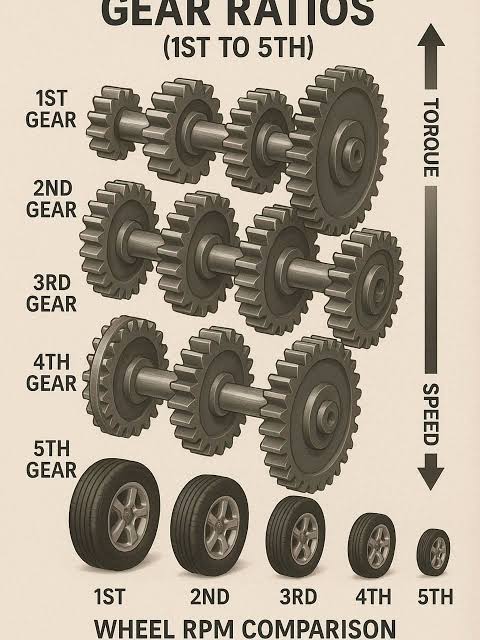
A gear ratio compares the number of turns the engine makes to the number of turns the wheels make. In a low gear the engine turns many times for each turn of the wheels. This multiplies torque, giving strong pulling power for moving off from rest, climbing hills or accelerating hard. In a high gear the engine turns fewer times for each wheel revolution. Torque multiplication drops, but engine speed stays lower at any given road speed, which usually reduces fuel consumption and noise.
First gear is the lowest ratio. It provides the greatest torque multiplication so the car can pull away smoothly even when loaded or on an incline. Second and third gears progressively reduce that multiplication while still offering useful acceleration. Higher gears, often fifth and sixth in manuals or the taller ratios in modern automatics, prioritise efficiency. At highway speeds these taller gears keep the engine turning more slowly, lowering fuel use and wear if the driver maintains a steady pace.
The practical effect on acceleration is straightforward. A car with relatively short (low) gearing will feel responsive when the driver asks for more speed. The engine climbs quickly through its power band and the vehicle gains speed with less delay. This is useful for overtaking on Nigerian dual carriageways or for merging into fast-moving traffic. The trade-off appears at higher speeds: the engine may run at higher revs than necessary, increasing fuel consumption and cabin noise. Conversely, a car with taller gearing accelerates more gently in the lower speeds but settles into relaxed, economical cruising once up to speed.
Fuel use is heavily influenced by the relationship between road speed and engine speed. When the engine operates in its most efficient range, typically a moderate band of revs where it produces good torque without working too hard, consumption improves. Tall top gears help achieve this on open roads. In heavy city traffic the benefit shrinks because the car spends most of its time in the lower gears anyway. Short journeys with repeated stops and starts keep the transmission in ratios that favour response over economy, regardless of how tall the highest gear may be.
Automatic transmissions have multiplied the number of ratios in recent years. Older four-speed units often forced a compromise: either lively acceleration or relaxed cruising, but rarely both. Six-, eight- and even ten-speed automatics provide more steps, so the engine can stay closer to its ideal speed whether accelerating or maintaining pace. The transmission computer selects the ratio that best matches the driver’s demand and the current conditions. In stop-start traffic these extra gears can still feel busy as the box shifts frequently, yet on a clear highway the taller ratios deliver noticeable calmness and better .
Continuously variable transmissions take a different approach. Instead of fixed gear steps they vary the ratio smoothly across a continuous range. In theory this keeps the engine at its most efficient speed more of the time. In practice many drivers notice a rising engine note under acceleration that feels different from a conventional gearbox. When well calibrated, a CVT can return excellent fuel figures in mixed driving. When less refined, the disconnect between engine speed and road speed can feel unnatural.
Manual gearboxes give the driver full control over the ratios. A skilled driver can hold a lower gear for stronger acceleration when needed or shift early into a higher gear for economy. The effectiveness depends on the spacing of the ratios and the engine’s torque characteristics. Closely spaced gears keep the engine in its sweet spot more easily; widely spaced gears may leave gaps where the engine feels either strained or sluggish.
Real-world conditions in Nigeria amplify the importance of these choices. Loaded vehicles, air-conditioning use, heat and frequent speed changes all affect how the transmission works the engine. A car with good low-gear torque multiplication pulls away cleanly even with four passengers and the air-conditioning running. On longer intercity runs, taller gearing helps keep fuel costs in check provided the driver resists the urge to rush. Poorly chosen or worn transmissions that slip or shift at the wrong moments waste both fuel and performance.When comparing vehicles it is useful to look beyond the simple number of gears. The actual ratios, the final drive ratio, and how the transmission is calibrated matter more. Test drives that include both brisk acceleration from low speeds and steady motorway cruising reveal how the gearing feels in practice. Listening to engine revs at 80 or 100 km/h in top gear gives a quick sense of whether the car is geared for relaxed economy or for more responsive performance.Gear ratios form the link between the engine’s output and the driver’s experience of acceleration and fuel consumption. Lower ratios multiply torque for strong response. Higher ratios reduce engine speed for efficiency and refinement. Modern multi-speed automatics and well-designed manuals try to offer the best of both, while CVTs aim for seamless efficiency. Matching the transmission’s character to the kind of driving done most often remains one of the more effective ways to balance performance and running costs on Nigerian roads.