
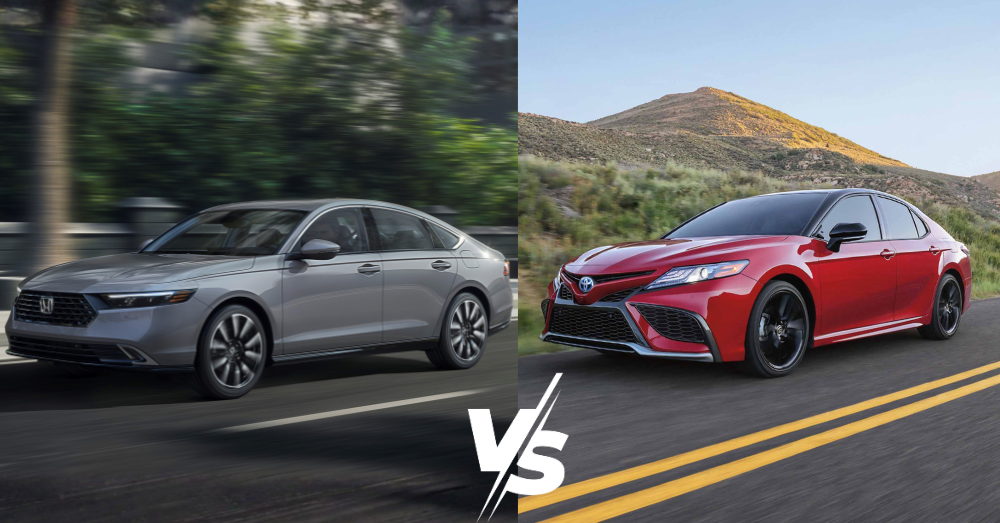
The Toyota Camry and Honda Accord have competed for decades as the default midsize saloons for buyers who want space, comfort and dependable engines. In the Nigerian Tokunbo market the comparison usually centres on the four-cylinder petrol versions that dominate imports. Looking closely at power, torque and the transmissions that deliver them shows where each car feels different in daily driving.
Most recent Camrys that reach Nigeria carry a 2.5-litre naturally aspirated four-cylinder. Output typically sits around 200 to 210 horsepower depending on the exact year and market, with torque in the region of 240 to 250 Nm. The engine is tuned for smooth, linear delivery rather than dramatic peaks. Power builds steadily as revs rise, giving the car a relaxed yet capable character when overtaking or carrying a full load of passengers and luggage. Older Camrys with the previous 2.4-litre or early 2.5-litre units offer slightly less power but retain the same easy-going nature and are still widely available and well understood by local mechanics.The Accord’s story splits more clearly by generation. Many 2013–2017 examples use a 2.4-litre naturally aspirated engine producing roughly 185 to 190 horsepower and similar torque to the contemporary Camry. From the tenth generation onward the volume engine in many markets became a 1.5-litre turbocharged four-cylinder. This smaller unit often delivers around 190 to 200 horsepower while producing noticeably stronger low- and mid-range torque, commonly quoted near 260 Nm. The turbo fills in the response that a larger naturally aspirated engine provides through displacement. A higher-output 2.0-litre turbo appeared on some sport-oriented Accords, but those remain less common in everyday Nigerian imports.
On paper the peak horsepower figures of the later Camry 2.5 and the Accord 1.5 turbo sit close to each other. The difference lies in how the torque arrives. The Camry’s larger naturally aspirated engine gives a progressive, predictable push that many drivers find reassuring. The Accord’s turbo delivers a stronger shove lower in the rev range, which can feel more responsive when moving off from traffic lights or when a quick burst of acceleration is needed in city traffic. Once both cars are at cruising speed the gap narrows and both feel adequately powered for Nigerian dual carriageways and expressways.Transmission choice shapes the driving experience as much as the engines themselves. Many Camrys of the last decade use a conventional six-speed automatic, while newer versions moved to an eight-speed automatic. These gearboxes provide distinct shift points and a familiar stepped feel. The Accord, especially in four-cylinder form, has relied heavily on continuously variable transmissions. A CVT keeps the engine in its efficient range and contributes to smooth progress, although some drivers prefer the more traditional shift character of the Camry’s geared automatics. Higher-powered Accord variants have used multi-speed conventional automatics, including ten-speed units on certain turbo models, but the CVT remains the most common pairing with the engines that dominate the used market.In real Nigerian conditions both powertrains prove durable when maintained.
The Camry’s larger naturally aspirated engine is often praised for simplicity and tolerance of varying fuel quality. The Accord’s turbocharged 1.5-litre unit is more modern and efficient on paper, yet it places greater importance on clean oil, healthy cooling and proper servicing intervals. Neglect can show up earlier in a turbo engine than in a straightforward 2.5-litre. Parts availability for both is strong, though the Camry’s sheer numbers on the road give it a slight edge in the speed and cost of routine repairs.Fuel economy in mixed driving tends to favour whichever car is driven more gently. The Accord’s turbo and CVT combination can return competitive figures when the turbo is not working hard. The Camry’s 2.5-litre with a conventional automatic is rarely far behind and sometimes feels less sensitive to aggressive throttle use. With air-conditioning running in heavy traffic both will consume more than laboratory claims; the practical difference between them is usually smaller than owners expect.
Hybrid versions of both models exist and change the comparison further. Camry hybrids pair a 2.5-litre engine with electric assistance for strong total system power and excellent efficiency. Accord hybrids use a similar approach with a 2.0-litre engine and electric motors. These deliver higher combined outputs and lower fuel use, but they remain a smaller share of the Tokunbo stock and require hybrid-specific knowledge for long-term ownership.For most Nigerian buyers the decision comes down to preferred power delivery and transmission feel. The Camry offers a larger, naturally aspirated engine with progressive torque and conventional automatic gearboxes that many find intuitive. The Accord counters with stronger low-end torque from its turbocharged options and the seamless character of its CVT.
Both provide more than enough performance for daily driving, overtaking and family use. Test-driving examples of each, paying attention to how the engine pulls from low revs and how the transmission responds in traffic, remains the surest way to decide which combination feels right.