
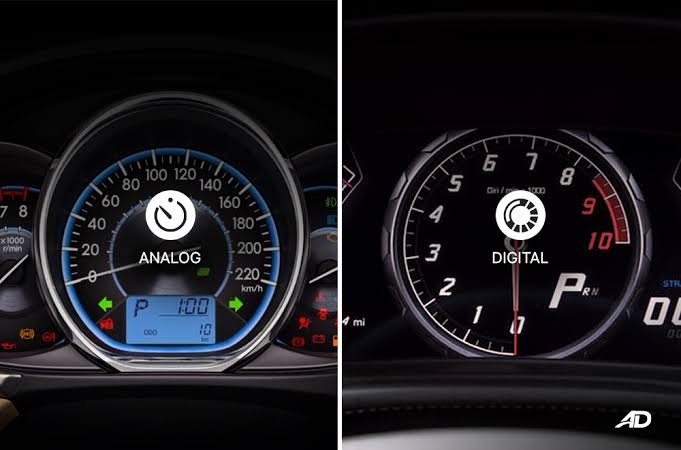
The instrument cluster is the driver’s primary source of information while the car is moving. It shows speed, engine condition, fuel level and a growing list of warnings and status messages. Over the past decade the traditional arrangement of physical dials has increasingly given way to digital screens, and the two approaches present information in distinctly different ways. Understanding the strengths and limitations of each helps drivers evaluate what they will actually see and use every day.Analog clusters rely on physical needles that move across marked dials. A typical layout places a speedometer and tachometer in the centre, with smaller gauges for fuel level and engine temperature. Warning lights occupy spaces between or around the dials. The design is simple, immediate and easy to read at a glance. The position of the needle against a fixed scale gives a quick sense of speed or engine revs without the need to interpret numbers. Many drivers find this intuitive, especially those who learned to drive with similar instruments. The hardware is generally robust and continues to function even if certain electronic modules elsewhere in the car develop faults.
Digital clusters replace the physical dials with a screen that can display information in multiple formats. Early versions used small monochrome displays set between conventional gauges. Later systems expanded into full-width TFT or LCD screens that can show large digital speed readouts, virtual dials, navigation maps, media information and configurable data panels. The driver or the vehicle’s computer can change what appears and how it is arranged. Some systems offer different themes or layouts that emphasise sport, efficiency or minimal information.The range of information available has expanded with the shift to digital displays. Both analog and digital clusters show the essentials: vehicle speed, fuel level, engine temperature and the main warning lights for oil pressure, charging system, airbags and stability control. Digital systems typically add a trip computer that displays instantaneous and average fuel consumption, range remaining, outside temperature and journey time. Many also show gear position, throttle or power output, tyre-pressure status and alerts from driver-assistance systems such as lane-departure or forward-collision warnings. Higher-end digital clusters can integrate turn-by-turn navigation instructions, incoming call information and audio track details so the driver does not need to look at the centre screen as often.
Clarity and legibility depend on execution as much as technology. A well-designed analog cluster with clear markings, good contrast and proper illumination remains easy to read in bright sunlight and at night. A poorly lit or cluttered analog layout can be harder to interpret. Digital screens offer high flexibility but must contend with reflection, brightness and resolution. In strong Nigerian sunlight some screens become difficult to read unless they are bright enough and properly shielded. At night an overly bright or busy digital display can distract, while a well-calibrated one can be dimmed and simplified for easier viewing.Configurability is a major advantage of digital clusters. Drivers can often choose to prioritise a large digital speedometer, display a virtual tachometer, show navigation arrows or monitor fuel economy in real time. Some systems allow the content to change automatically according to driving mode. Analog clusters offer little or no such flexibility; the layout is fixed at the factory.
For drivers who value the ability to tailor information to the journey, the digital approach provides clear benefits.Reliability and long-term behaviour also differ. Analog gauges have fewer complex electronic components in the cluster itself and can remain serviceable for many years with basic care. Digital screens introduce the possibility of pixel failures, software glitches or complete display blackouts if the control module develops a fault. In practice modern digital clusters from reputable manufacturers have proven durable, yet repairs can be more expensive when problems do occur.
On Tokunbo vehicles the age of the electronics becomes relevant; a ten-year-old digital display may show signs of fading or slow response that a simpler analog cluster of the same age would not.The transition period produced many hybrid designs. A common arrangement retains physical speed and rev gauges while placing a multi-information display between them. This compromise preserves the intuitive needle movement for the most critical data while adding the trip computer and warning messages that drivers now expect. Many popular models from the mid-2010s to early 2020s use exactly this layout, giving a useful middle ground.
When assessing a vehicle it is worth sitting in the driver’s seat and observing the cluster under different conditions. Check how clearly the speed can be read at a glance. Note whether important warnings are obvious. Explore any available menus to see what additional information can be displayed and how easily it can be accessed without taking attention far from the road. Bright sunlight and night-time visibility both deserve attention. The presence of a digital or hybrid cluster does not automatically make a car better; the quality of the implementation and the usefulness of the information shown matter more.Analog clusters deliver simplicity, reliability and immediate visual understanding through the position of needles on fixed scales.
Digital clusters offer greater flexibility, more data and the ability to adapt the display to different needs. Hybrid designs attempt to capture the best of both. The most effective instrument panel is the one that presents essential information clearly, minimises distraction and remains legible in the lighting conditions the driver actually encounters. Evaluating those qualities on the specific car under consideration remains the surest way to decide which approach will prove more satisfactory over years of daily use.