
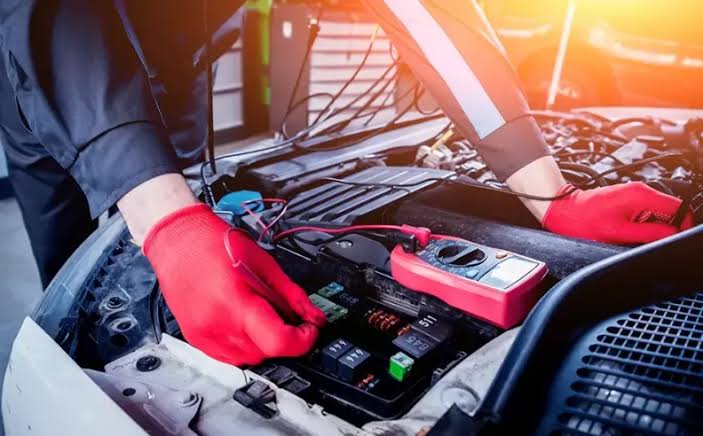
Car electronics can be tricky when they act up. One day your headlights are fine, the next they flicker like a bad movie scene, or the radio cuts out mid-song. These problems stem from the electrical system that powers everything from the starter to the AC. The good news is that most issues are straightforward to diagnose at home with basic tools. You do not need to be a mechanic—just patient and systematic. Common culprits include the battery, alternator, fuses, wiring, or sensors. Let us go through how to check each one, explained so you can follow along and fix what you can before calling a pro.
Start with the Battery: The Power Source
The battery supplies electricity to start the engine and run accessories. If your car clicks but will not start, or lights dim when you rev, the battery is often weak. Heat and short trips kill batteries fast here, lasting only 2–3 years on average.To test: Use a multimeter (cheap at ₦3,000). Set to DC volts, touch the red probe to the positive terminal (+) and black to negative (-). A healthy battery reads 12.6 volts or higher when off. Below 12.4 means it needs charging or replacing. With the engine running, it should jump to 13.7–14.7 volts lower means the alternator is not charging it. Clean corroded terminals with baking soda and water, scrub with a brush, rinse, dry, and tighten. If voltage is good but issues persist, the battery might have a bad cell—load test at a shop for free.
Check the Alternator: The Charging System
The alternator generates power while driving, recharging the battery and running electronics. If it fails, the battery drains fast, causing dim lights, weak AC, or eventual no-start.Troubleshoot by starting the car and revving to 2,000 RPM—multimeter should show 13.7–14.7 volts at the battery. If steady at 12 volts or dropping, the alternator is bad. Listen for whining noises (bad bearings) or smell burning rubber (slipping belt). Check the belt for cracks or looseness—tighten or replace if needed. A failing alternator often triggers the battery light on the dash. Replacement costs ₦20,000–₦40,000; test first to confirm.
Inspect Fuses and Relays: The Electrical Guards
Fuses protect circuits from overloads, and relays control high-power items like the fuel pump or headlights. A blown fuse cuts power to that circuit, causing things like no radio or dead power windows.Locate the fuse box—usually under the dash or hood (manual shows it). Pull fuses one by one with pliers or your fingers—look for a broken wire inside. Replace with the same amp rating (color-coded). For relays (small black boxes), swap with a similar one (like horn relay for AC) to test—if the problem moves, the relay is bad. These are cheap fixes (₦500–₦2,000) but common in our humid weather where corrosion hits connections.
Look for Wiring and Connection Problems
Loose or corroded wires cause intermittent issues like flickering lights or random stalls. Heat and vibration loosen things over time.Start under the hood: inspect battery cables for tight, clean connections. Wiggle harnesses near the engine— if symptoms change, there is a loose wire. Check grounds (black cables bolted to the frame)—corrosion here starves the system of power. Inside, under the dash, look for chewed wires from rodents (common here) or melted insulation from shorts. Use a multimeter for continuity: set to ohms, touch probes to wire endslow resistance means good; infinite means broken. Fixes range from tightening (free) to splicing new wire (₦5,000 at a shop).