
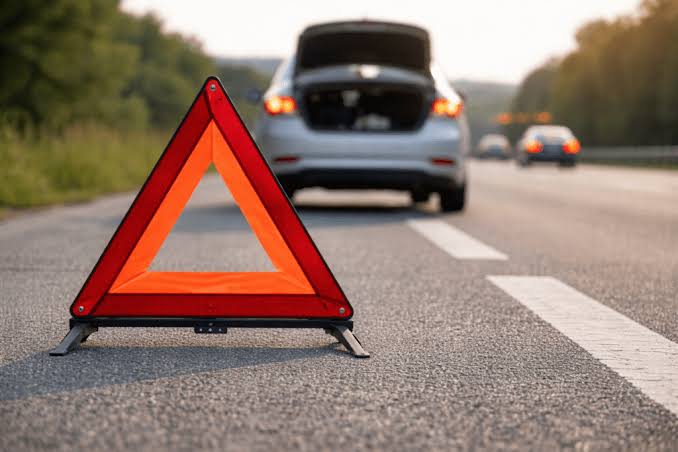
Hazard lights are one of the simplest safety tools fitted to every vehicle, yet they are frequently misunderstood and misused on Nigerian roads. When applied correctly, they alert other drivers to a temporary danger and reduce the chance of secondary crashes. When used wrongly, they create confusion and can themselves become a hazard. Understanding the proper purpose and timing of hazard lights helps every motorist contribute to safer highways.
Hazard warning lights are designed primarily for stationary or nearly stationary situations where your vehicle has become an unexpected obstruction. The most common and correct uses include a breakdown on the carriageway or hard shoulder, involvement in a crash that leaves the vehicle blocking or partly blocking the road, or a sudden stop caused by an immediate danger ahead such as floodwater, a fallen tree, an oil spill, or debris. In dense fog, once you have pulled off the road to a safe place, hazard lights can also help other drivers see that a vehicle is stopped.
On dual carriageways and expressways such as the Lagos-Ibadan Expressway, Abuja-Lokoja Road, or similar high-speed corridors, early activation of hazard lights is especially important. Approaching drivers need maximum warning time. Switch them on as soon as you realise you must stop or have already become stationary in a risky position. Combine the lights with a warning triangle placed a generous distance behind the vehicle ideally 50 metres or more on high-speed roads so that drivers have time to react.
Equally important is knowing when not to use hazard lights. They should not be left on while the vehicle is moving under normal driving conditions. Using them in heavy rain or fog while still driving is a widespread habit, but it is not the correct approach. In poor visibility, low-beam headlights are the proper tool; hazard lights can mask your indicators and make it harder for others to understand your intentions if you need to change lanes or turn. Driving with hazards on in a convoy or as a general “caution” signal also confuses other road users who cannot tell whether you are slowing for a real emergency or simply driving with the lights activated out of habit.
Another common misuse is activating hazard lights to say “thank you” after being allowed to merge or to signal that you are allowing someone else to pass. While the intention may be polite, the flashing lights can be misread by drivers further back as a warning of danger, causing unnecessary braking or swerving. Indicators exist for communication about direction; hazard lights exist to warn of a hazard.
Maintenance matters. Both front and rear hazard bulbs should work. A single failed bulb reduces the effectiveness of the warning, especially at night or in rain. Checking the hazard function during routine vehicle inspections takes only seconds and ensures the system is ready when needed. Keeping a functional warning triangle in the vehicle remains essential because lights alone are not always sufficient, particularly if the battery is weak or the electrical system is compromised after a crash.
When you do stop on a highway, the sequence should be clear. Activate the hazard lights immediately, move the vehicle as far off the live carriageway as safety allows, exit from the side away from traffic if possible, place the warning triangle at an appropriate distance, and then call for assistance using FRSC’s emergency number 122 or other relevant help lines. Passengers should stand well clear of the road. These steps, combined with visible hazard lights, give approaching drivers the best chance of seeing the obstruction in time.
Commercial drivers and fleet operators have a particular duty to ensure every vehicle has working hazard lights and that drivers understand their correct use. A trailer or bus stopped without warning lights on a dark stretch of highway creates an extreme risk for everyone else on the road.
Correct use of hazard lights is a small action with a large safety impact. Switch them on when your vehicle has become a temporary hazard, keep them off during ordinary driving, maintain the bulbs, and always pair them with a properly placed warning triangle on the highway.
These habits reduce confusion, prevent secondary collisions, and make Nigerian roads safer for all users. In an emergency, clear communication through the right lights can make the difference between a managed stop and a serious crash.