
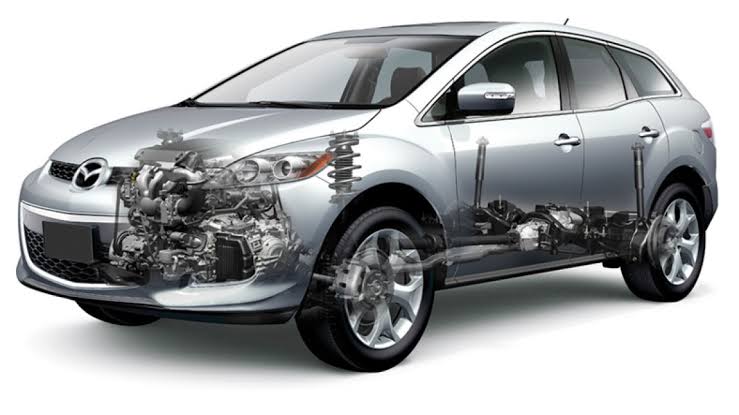
All-wheel drive is often listed as a desirable feature on crossover SUVs, yet the way torque is actually shared between the front and rear wheels varies widely. The torque split determines how the system behaves on slippery surfaces, during hard acceleration and in everyday driving. Understanding the differences helps buyers evaluate whether a particular AWD setup will deliver meaningful benefits on Nigerian roads or mainly add weight and complexity.
Most crossover SUVs use on-demand or reactive all-wheel-drive systems rather than full-time four-wheel drive with low-range gearing. In normal conditions the vehicle drives primarily through the front wheels, which is more efficient and reduces driveline losses. When sensors detect wheel slip, or when the driver demands strong acceleration, a coupling sends a portion of torque to the rear axle. The exact amount that can be sent, and how quickly it arrives, defines the character of the system.A common arrangement is a front-biased split that defaults to roughly 100 percent front-wheel drive and can transfer up to 50 percent of available torque to the rear when needed. Some systems are calibrated to send a smaller maximum percentage, while others can approach a more even distribution under certain conditions. The coupling may be a multi-plate clutch controlled electronically, or in some designs a more mechanical device. Electronic control allows the system to respond to throttle position, steering angle, yaw rate and individual wheel speeds, adjusting the split many times per second.
Full-time systems that maintain a permanent split, such as a fixed 60/40 or 40/60 distribution, appear less often on car-based crossovers and more frequently on vehicle lines with stronger off-road heritage. These setups keep both axles involved continuously, which can improve stability and traction on loose or uneven surfaces, though they usually carry a small efficiency penalty. Some advanced systems use a centre differential that can vary the split across a wide range and lock completely when maximum traction is required.The practical difference shows up most clearly when grip is limited. On wet roads, sandy patches, light mud or gravel, an AWD system that can send significant torque rearward helps the vehicle pull away cleanly and maintain progress without excessive front-wheel spin. During brisk acceleration on dry roads the rear torque contribution can improve stability and reduce the sensation of torque steer that pure front-wheel-drive cars sometimes exhibit. In steady highway cruising most systems revert to front-drive bias, so the efficiency penalty remains modest.Popular crossover models illustrate the range of approaches.
Many Toyota and Honda crossovers use electronically controlled couplings that keep the vehicle in front-wheel drive until slip is detected, then progressively engage the rear axle. The maximum rear torque figure is often in the region of 50 percent, though real-world delivery depends on conditions and calibration. Subaru’s symmetrical all-wheel-drive systems traditionally maintain a more permanent distribution, giving a distinctive balance that many drivers notice in the wet or on uneven surfaces. Other manufacturers offer similar on-demand systems with their own control logic and maximum split values. Higher-performance or more off-road-oriented versions sometimes add locking functions or more aggressive calibration.In Nigerian conditions the value of these systems depends on the routes driven. For mostly paved city and highway use the benefit is greatest in heavy rain, when roads develop slippery films of oil and water, or when one side of the vehicle drops onto a soft shoulder. Drivers who regularly encounter unpaved estate roads, construction zones, or rural laterite sections gain more from a system that can respond quickly and send substantial torque rearward. Deep mud, severe ruts or genuine off-road obstacles may still exceed the ability of a typical crossover AWD system, which lacks low-range gearing and the ground clearance of dedicated four-wheel-drive vehicles.Several limitations are worth noting. On-demand systems need a small amount of slip or a clear demand signal before they act.
In some situations the engagement can feel slightly delayed compared with a full-time system. Extra driveline components add weight and complexity, which can affect fuel consumption and long-term maintenance costs. Tyre condition remains critical; mismatched or worn tyres can confuse the control system and reduce effectiveness. The AWD system cannot overcome inadequate ground clearance or poor approach angles when the obstacle is simply too large.When evaluating a crossover the published torque-split figure, where available, gives a useful clue to capability. A system that can send half its torque to the rear axle has more potential to help in low-grip situations than one limited to a smaller percentage. Equally important is how quickly and smoothly the system responds. Test drives on wet or loose surfaces, where safe and legal, reveal more than specification sheets alone. Checking that the system engages without excessive noise or vibration, and that any dashboard indicators function correctly, adds further reassurance.
All-wheel-drive torque split is not a single standard. It ranges from primarily front-wheel-drive systems that transfer modest amounts of torque rearward only when needed, to more permanent or more aggressive distributions that keep both axles involved. For most crossover buyers the on-demand systems fitted to popular models provide a worthwhile increase in traction and stability in everyday low-grip conditions without the full complexity of traditional off-road four-wheel drive. Matching the system’s character to the actual roads driven, and maintaining the vehicle properly, allows the hardware to deliver the extra confidence it was designed to provide.